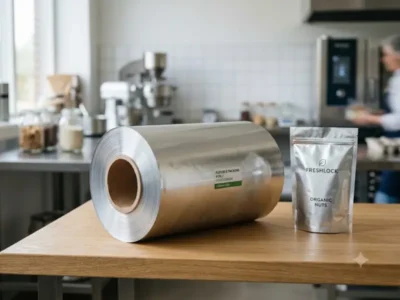
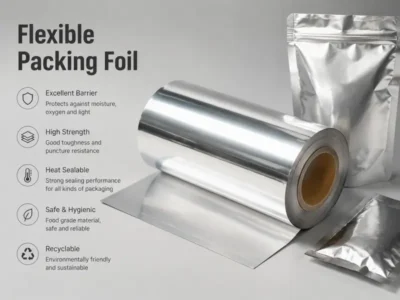
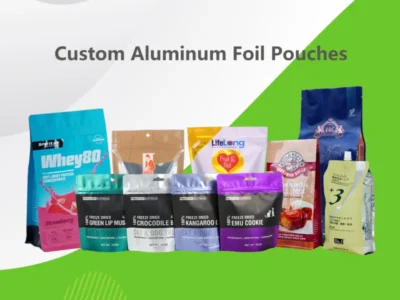
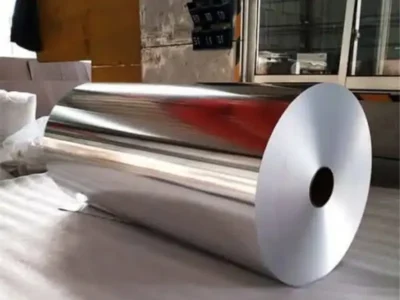
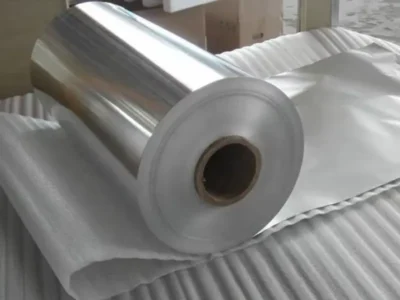
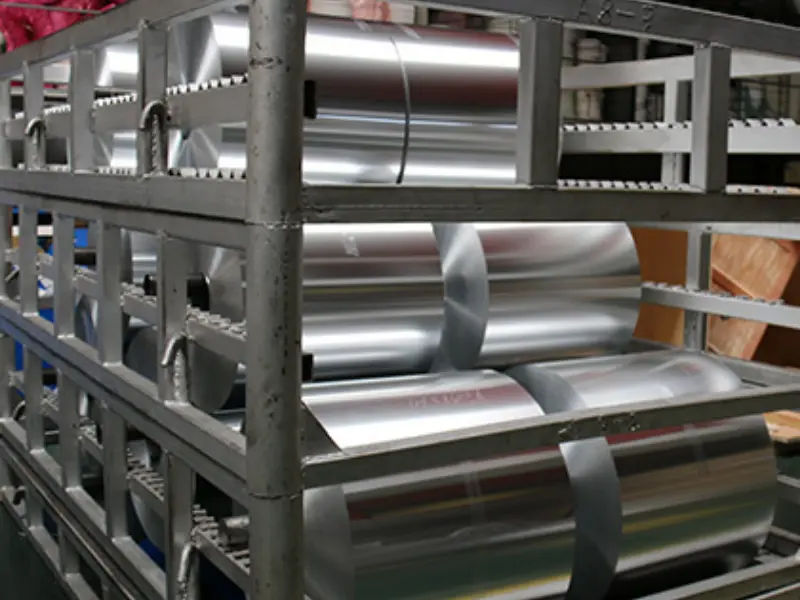
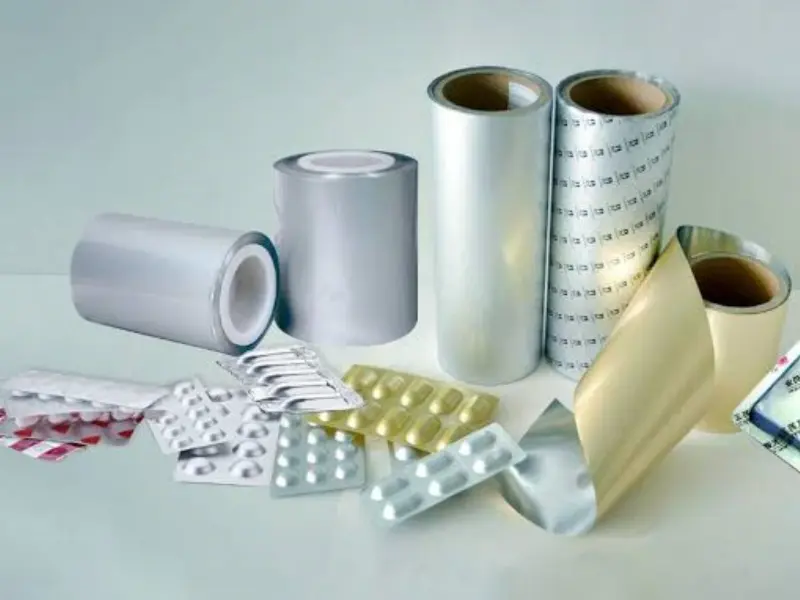
Flexible packing foil is the barrier layer inside most modern food, beverage, pharmaceutical, and personal care packaging.
It is the reason your coffee stays fresh for 18 months, your medication stays stable in a blister pack, and your snack bag does not let air in.
What Flexible Packing Foil Actually Does
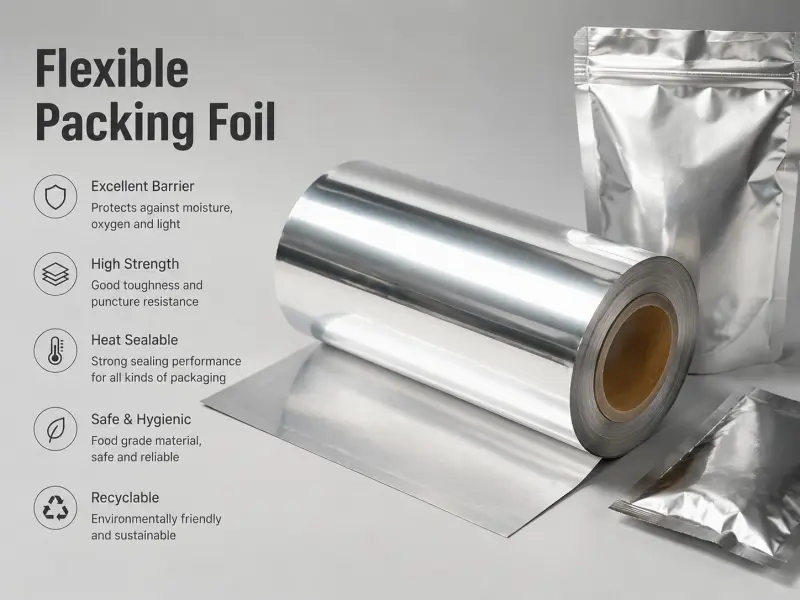
Aluminium foil as a packaging barrier blocks four things that destroy product shelf life:
→ Oxygen — causes oxidation, rancidity, and color change → Moisture — causes microbial growth, caking, and spoilage → Light — degrades vitamins, flavors, and active pharmaceutical ingredients → Odor and gas — allows off-flavors to enter and product aromas to escape
At 0.006mm to 0.025mm thickness, aluminium foil provides complete barrier to all four when the foil layer is pinhole-free. Below about 0.009mm, micro-pinholes appear naturally in the foil due to the rolling process.
These are filled by the plastic lamination layers in the final structure, which is why flexible packaging foil is always used in combination with plastic and paper layers — never as a standalone layer.
Foil vs Metallized Film — The Key Difference
Metallized film (plastic film with a very thin vacuum-deposited aluminium layer, typically 30–100 nanometers) is often confused with foil. They perform very differently:
| Feature | Aluminium Foil | Metallized Film |
|---|---|---|
| Aluminium layer thickness | 6,000–25,000 nm | 30–100 nm |
| Oxygen barrier | Complete (OTR < 0.01) | Partial |
| Moisture barrier | Complete | Partial |
| Light barrier | 100% | ~99% |
| Metal detection | Yes | No |
| Recyclability | Complicates recycling | Complicates recycling |
| Cost | Higher | Lower |
| Use when | Maximum shelf life needed | Cost reduction priority |
For products with 12+ month shelf life targets, pharmaceutical stability requirements, or aseptic filling, aluminium foil is the correct choice. Metallized film suits shorter shelf life applications or when cost matters more than ultimate barrier.
Alloys Used in Flexible Packing Foil — What Each Does
Not every alloy rolls to ultra-thin gauges without pinholes. Flexible packaging foil uses a narrow set of alloys optimized for thin-gauge rolling.
8079 Alloy Flexible Packing Foil— The Flexible Packaging Standard
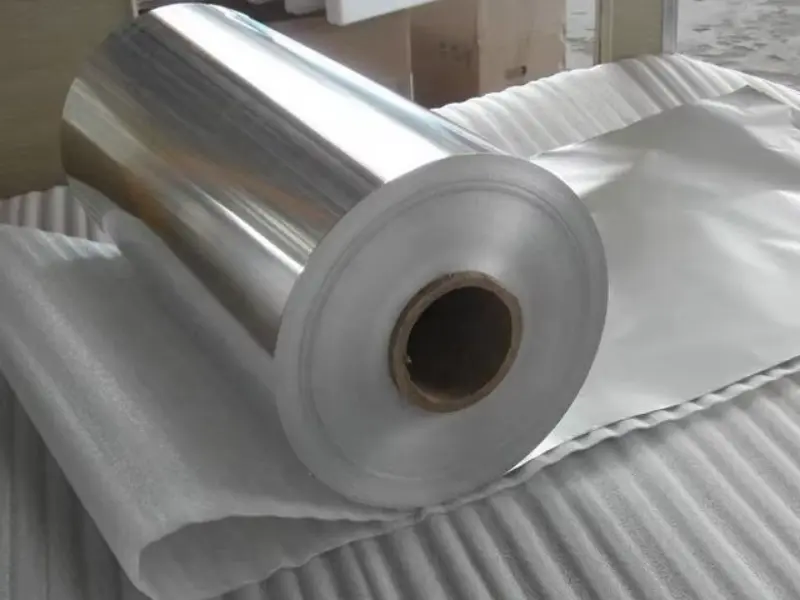
8079 is the most widely used alloy for ultra-thin flexible packaging foil. Its iron and silicon content gives good rolling performance at thin gauges, and the resulting foil is flexible enough for lamination and pouch forming without cracking. It is the default alloy for lamination foil below 0.020mm.
| Property | Value |
|---|---|
| Aluminium content | ~98.0% |
| Iron (Fe) | 0.70–1.30% |
| Silicon (Si) | 0.05–0.30% |
| Typical temper | O (fully annealed) |
| Thickness range | 0.006–0.020mm |
| Pinhole count | Very low at 0.007mm+ |
8011 Alloy Flexible Packing Foil— Food and Pharmaceutical Grade
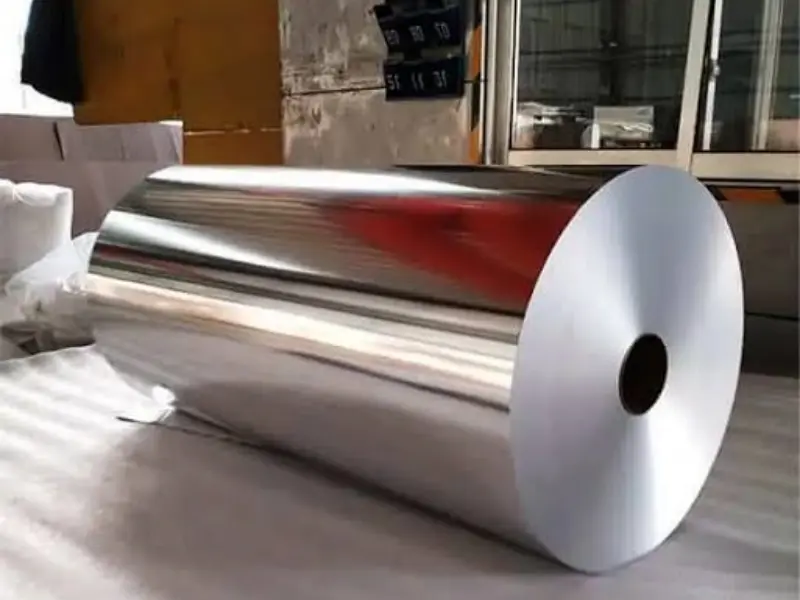
8011 is the standard alloy for household foil, food container foil, pharmaceutical blister foil, and some lamination applications. Slightly lower iron content than 8079 but still good thin-gauge rolling performance. Wide use across the foil industry means it is competitively priced.
1235 Alloy Flexible Packing Foil— High-Purity, Bright Surface
1235 is purer than 8079 and 8011 — minimum 99.35% aluminium. It gives a brighter, more reflective surface and slightly better ductility at very thin gauges. Used in applications where surface brightness matters (beverage can lids, premium packaging) and in battery foil where purity affects electrochemical performance.
8021 Alloy Flexible Packing Foil— Lidding and Seal Foil

8021 has a higher iron content than 8079 and gives slightly stiffer foil suitable for heat-seal lidding applications and thicker flexible packaging uses (0.020–0.060mm). It is the standard for pharmaceutical blister overwrap and food tray lidding.
Alloy Comparison for Flexible Packaging
| Alloy | Min Al% | Best Thickness | Typical Use | Price Level |
|---|---|---|---|---|
| 8079-O | ~98.0% | 0.006–0.020mm | Laminate pouches, sachets | Base |
| 8011-O | ~98.6% | 0.009–0.040mm | Food wrap, pharma, household | Base |
| 1235-O | 99.35% | 0.006–0.025mm | Premium packaging, battery | +5–10% |
| 8021-O | ~97.8% | 0.018–0.060mm | Lidding, seal foil, blister overwrap | Base |
Thickness Guide — Matching Gauge to Application
Flexible packing foil runs from the ultra-thin lamination layers used in snack pouches to the thicker semi-rigid material used in food trays and blister overwrap. Each thickness range has a different use case.
Ultra-Thin Foil — 0.005mm to 0.010mm
This is the thinnest technically viable foil for flexible packaging. At 0.006–0.007mm, the foil contains micro-pinholes but still provides excellent barrier when laminated with plastic films. Used in:
- Coffee and tea laminate sachets
- Confectionery and snack bag inner layer
- Condiment and single-serve portion sachet
- Detergent pod laminate
- Personal care product laminate pouch
| Thickness | Pinholes | Barrier (laminated) | Weight /m² |
|---|---|---|---|
| 0.005mm | High | Good (laminated) | ~13.6g |
| 0.006mm | Moderate | Very Good | ~16.3g |
| 0.007mm | Low-moderate | Excellent | ~19g |
| 0.009mm | Very low | Complete | ~24.4g |
Standard Lamination Foil — 0.010mm to 0.020mm
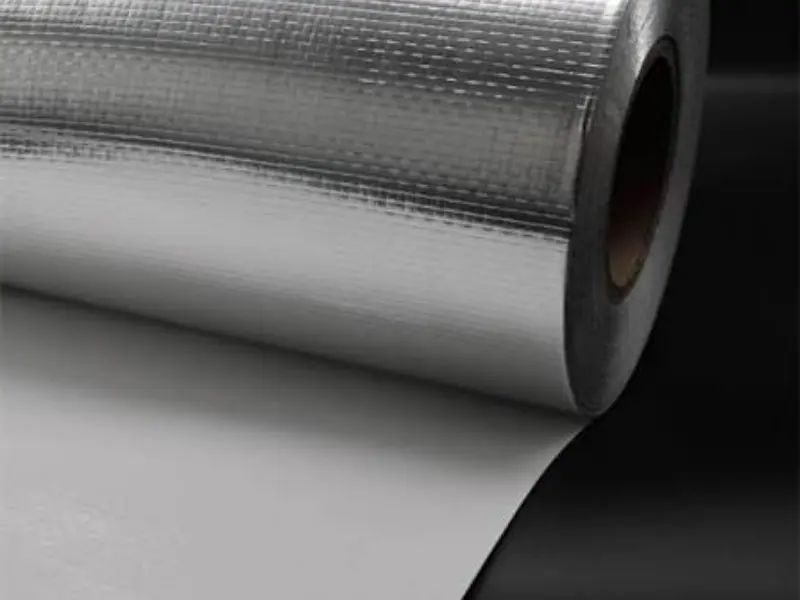
The most used range for flexible packaging. Pinhole count at this thickness is very low to zero. Provides complete barrier without relying on lamination films to fill pinholes. Used in:
Vacuum-sealed meat and fish inner wrap
Retort pouch inner barrier layer
Juice and dairy drink carton barrier
Aseptic brick pack (Tetra Pak style) foil layer
Baby food pouch barrier
Pharmaceutical and Technical Foil — 0.016mm to 0.030mm
Pharmaceutical packaging has the strictest foil quality requirements. The foil must have zero pinholes, consistent thickness, clean surface (no rolling oil contamination), and may carry a heat-seal lacquer or print primer coating.
| Thickness | Use | Pinhole Requirement |
|---|---|---|
| 0.016mm | Strip pack (push-through) | Zero per m² |
| 0.020mm | Standard blister pack | Zero per m² |
| 0.025mm | Child-resistant blister | Zero per m² |
| 0.030mm | Overwrap seal foil | Zero per m² |
Semi-Rigid Foil — 0.030mm to 0.080mm
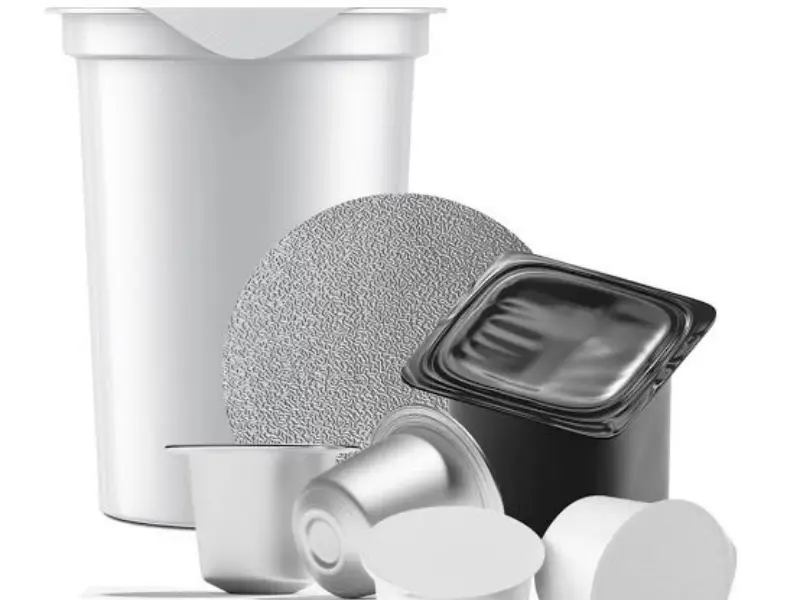
Thicker foil that forms into containers, lids, and trays. Still classified as flexible packaging because it can be peeled, bent, and formed — but it holds its shape after forming. Used in:
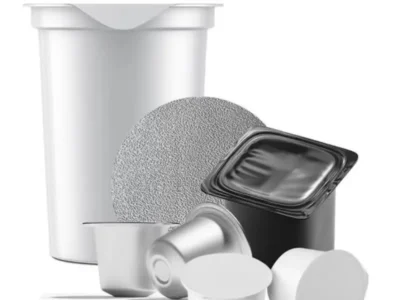
- Ready-meal tray lids (peel-off lidding foil)
- Dairy product pot lids (yogurt, cream cheese)
- Airline meal tray covers
- Portion cup and cream lids
- Food service container lids
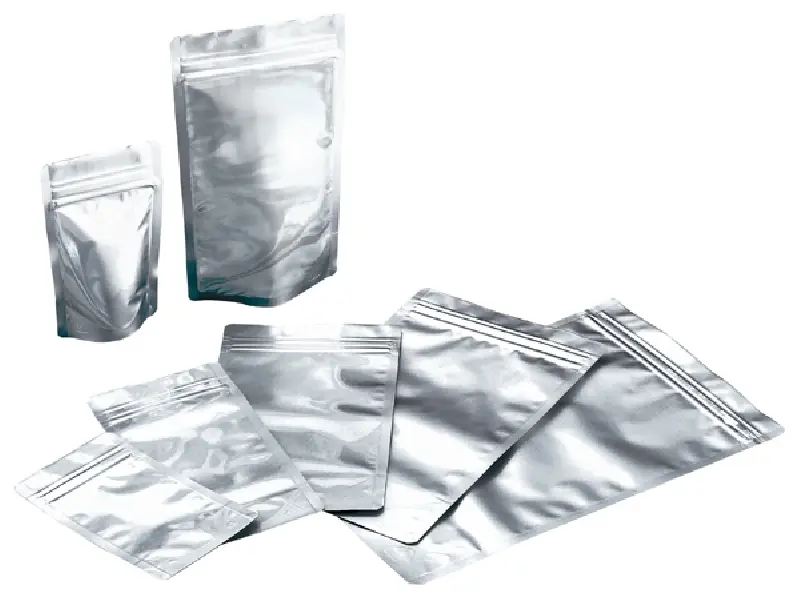
Lamination Structures — How Flexible Packing Foil Is Used in Practice
Flexible packing foil is almost never used alone. It is combined with plastic films and sometimes paper in multi-layer laminate structures. The foil provides barrier; the other layers provide strength, printability, heat-seal function, or stiffness.
Common Flexible Laminate Structures
PET / Foil / PE (Three-Layer Laminate)
The most common structure for food pouches, snack bags, and retort packs.
| Layer | Material | Function |
|---|---|---|
| Outer | PET (polyester) 12–15µm | Printable, strong |
| Middle | Aluminium foil 7–12µm | Complete barrier |
| Inner | PE (polyethylene) 50–80µm | Heat seal, food contact |
OPP / Foil / PE (Coffee and Snack)
Used for coffee pouches, dry snack packaging, and confectionery.
| Layer | Material | Function |
|---|---|---|
| Outer | OPP (oriented polypropylene) | Gloss print surface |
| Middle | Aluminium foil 6–9µm | Oxygen and moisture barrier |
| Inner | PE or CPP | Heat seal |
PET / Foil / Nylon / PE (Retort and High-Barrier)
For products that are filled and then heat-sterilized (retort processing). The nylon layer adds puncture resistance.
| Layer | Material | Function |
|---|---|---|
| Outer | PET 12µm | Print, strength |
| Foil | Aluminium 9µm | Barrier |
| Middle | Nylon 15µm | Puncture, flex resistance |
| Inner | PE or cast PP 80µm | Heat seal, retort-safe |
Paper / Foil / PE (Aseptic Carton Style)
Brick-style liquid cartons use this structure on the inner barrier layer.
| Layer | Material | Function |
|---|---|---|
| Outer | Paper | Structure, print |
| Middle | Aluminium foil 6–9µm | Barrier |
| Inner | PE | Food contact, heat seal |
Applications by Industry
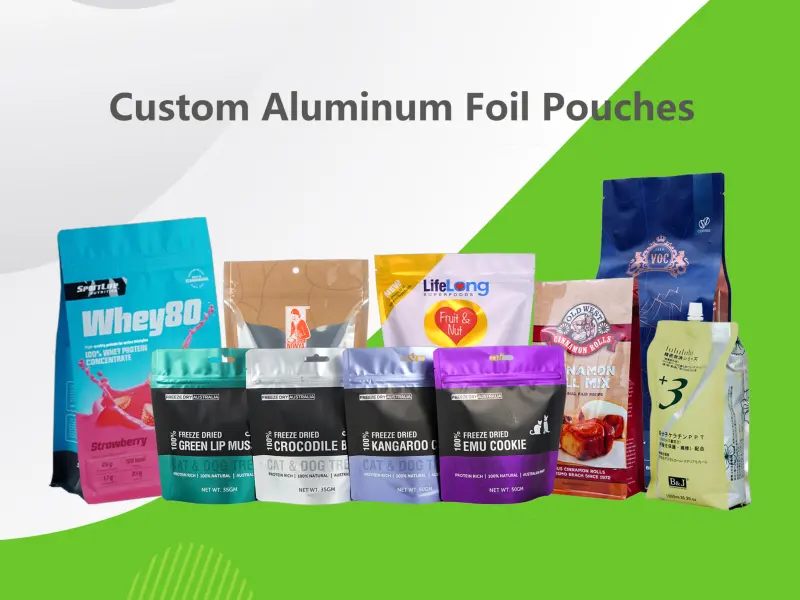
Food Packaging
Flexible foil packaging dominates in:
- Snack foods: crisps, nuts, and biscuits in multi-layer foil laminates
- Coffee: ground coffee in valve pouches with foil barrier layer
- Tea: individual teabag outer wrap and bulk tea pouches
- Confectionery: chocolate bar wrappers, candy twist wrap
- Dairy: butter wrap, cheese slices, yogurt lids
- Ready meals: retort pouches and tray overwrap
- Baby food: aseptic pouches with full foil barrier
Pharmaceutical Packaging
- Blister packs for tablets and capsules (0.020–0.025mm, zero pinhole)
- Strip pack (push-through foil) for single-dose medication
- Sachets for powder and granule medication
- IV bag overwrap for sterile fluid packaging
- Child-resistant foil lidding for controlled medication
Personal Care and Cosmetics
- Single-serve cosmetic sachet (face mask, conditioner, serum)
- Wet wipe packaging foil laminate
- Hair color sachet inner barrier
- Luxury cosmetic pouch foil layer
- Soap and detergent portion sachet
Industrial and Technical
- Thermal insulation facing foil (building wraps)
- Vacuum-sealed industrial component packaging
- Moisture-sensitive electronic component packaging
- Chemical product sachet and pouch
- Pet food pouch inner barrier layer
Surface Treatments and Coatings on Flexible Packing Foil
Plain foil is rarely used directly in a laminate. Most flexible packaging foil carries one or more surface treatments.
Heat-Seal Lacquer
A thin coating applied to one face of the foil that allows the foil to bond to itself or to a PE/PP film under heat and pressure. Used in:
- Pharmaceutical blister packs (lacquer on the foil side that seals to the PVC or PVDC blister cavity)
- Food lidding applications where foil seals to tray
Print Primer
A coating that improves ink adhesion on the foil surface. Applied before printing when the foil will carry printing directly rather than relying on the outer laminate layer for graphics.
Annealing and Oil Control
Flexible packaging foil must be fully annealed (O temper) to be flexible without cracking. Surface oil from the rolling process must be controlled below specification levels — typically 5–10 mg/m² for food-grade foil and below 5 mg/m² for pharmaceutical and battery applications.
Price Reference for Flexible Packing Foil
Factory Direct Price by Type (2024–2025)
| Foil Type | Alloy | Thickness | Width | Price /ton (USD) |
|---|---|---|---|---|
| Lamination foil, plain | 8079-O | 0.007mm | 600–1600mm | 3,600–4,500 |
| Lamination foil, plain | 8079-O | 0.009mm | 600–1600mm | 3,400–4,200 |
| Lamination foil, plain | 1235-O | 0.007mm | 600–1200mm | 3,800–4,700 |
| Pharmaceutical foil, lacquered | 8011-O | 0.020mm | 300–800mm | 3,800–4,600 |
| Lidding foil, heat-seal | 8021-O | 0.030mm | 200–600mm | 3,500–4,200 |
| Food container foil | 8011-O | 0.050–0.080mm | 200–800mm | 3,000–3,600 |
What Adds to the Price
→ Narrower width: Below 300mm requires an extra slitting step — adds USD 80–180/ton → Lacquer coating: Heat-seal or print primer coating adds USD 200–400/ton → Pharmaceutical grade: Zero-pinhole certification and tighter QC adds USD 300–600/ton → Tighter thickness tolerance: ±0.0005mm vs ±0.001mm adds cost → Small order size: Below 3 tons, expect 15–25% premium over mill pricing
Comparing Foil Grades — Choosing the Right Spec
Ultra-Thin (0.006–0.007mm) vs Standard (0.009–0.012mm)
| Feature | 0.006–0.007mm | 0.009–0.012mm |
|---|---|---|
| Pinholes | Micro-pinholes present | Very low to zero |
| Barrier alone | Requires lamination fill | Near-complete alone |
| Weight per m² | 16–19g | 24–32g |
| Cost per ton | Highest | High |
| Cost per m² | Lowest (thin) | Moderate |
| Best use | High-volume snack laminate | Retort, pharmaceutical |
8079 vs 8011 for Flexible Packaging
| Feature | 8079-O | 8011-O |
|---|---|---|
| Rolling performance (thin) | Slightly better | Good |
| Surface brightness | Good | Good |
| Typical thickness | 0.006–0.015mm | 0.009–0.040mm |
| Common use | Ultra-thin laminate | Household, pharma, food |
| Price difference | Similar | Similar |
For most flexible packaging laminates at 0.007–0.009mm, 8079 and 8011 are interchangeable. 8079 is more common below 0.009mm; 8011 dominates above 0.012mm.
Buying Flexible Packing Foil from China
Why China Leads in Flexible Packaging Foil Supply
Chinese foil mills produce the majority of global flexible packaging foil, particularly the ultra-thin grades used in laminate structures. Key producers operate large multi-stand cold rolling mills with foil-grade tension control systems. Pricing runs 20–35% below comparable European converter pricing for equivalent specifications.
How to Specify an Order Correctly
| Item | What to Specify |
|---|---|
| Alloy | 8079, 8011, 1235, or 8021 |
| Temper | O (annealed) for all flexible packaging |
| Thickness | Nominal in mm, ± tolerance |
| Width | In mm — confirm matches your slitter or laminator |
| Coil OD / ID | Must match your laminator unwind system |
| Surface | Plain, lacquered (specify lacquer type), primer |
| Oil level | Specify max mg/m² for pharma or battery use |
| Pinhole spec | Per m² count or zero requirement |
| Quantity | Tons per delivery |
| Standard | EN 546 or ASTM B479 |
Lead Time and Shipping
| Product | Production Time | Sea Transit |
|---|---|---|
| Standard lamination foil (8079, 0.007mm) | 15–25 days | 20–40 days |
| Pharma blister foil (lacquered) | 20–30 days | 20–40 days |
| Lidding foil (coated) | 20–28 days | 20–40 days |
| Ultra-thin below 0.007mm | 25–35 days | 20–40 days |
Frequently Asked Questions
What Is the Difference Between Flexible Packing Foil and Household Foil
Household foil is typically 0.009–0.015mm thick, uncoated, and supplied in retail rolls. Flexible packing foil for industrial lamination is typically 0.006–0.020mm, may carry coatings (lacquer, primer), is supplied in wide coils (up to 1600mm), and must meet tighter quality standards for pinhole count, oil residue, and thickness uniformity. Household foil is a finished consumer product. Flexible packing foil is an industrial raw material for lamination converters.
What Alloy Is Best for Ultra-Thin Flexible Packaging Foil
8079-O is the most common choice for lamination foil below 0.010mm. Its iron content supports good rolling performance at ultra-thin gauges. 1235-O is used when higher surface brightness is needed or when purity matters (as in battery-adjacent applications). 8011-O works well above 0.012mm and is the most widely produced alloy globally.
How Many Pinholes Is Acceptable in Flexible Packing Foil
For general food laminate applications using 0.007mm foil, micro-pinholes are present and accepted because the plastic lamination fills them. For pharmaceutical blister foil (0.016–0.025mm), zero pinholes per m² is the standard requirement. For 0.009mm and above in food retort applications, pinhole count should be near zero to ensure barrier integrity without relying entirely on the lamination layers.
Can Flexible Foil Be Printed Directly
Yes. Foil can be printed using gravure, flexographic, or digital printing methods after applying a print primer. Most commonly, however, printing is applied to the outer plastic film (PET or OPP) in the laminate rather than directly to the foil. Direct foil printing is used in some premium confectionery wrap and pharmaceutical blister applications.
What Is the MOQ for Flexible Packing Foil from Chinese Mills
Standard MOQ from Chinese rolling mills is 3–5 tons per specification (alloy, temper, thickness, width). For coated grades (lacquered or primed), MOQ may be 5–10 tons due to coating line setup. Small quantities below MOQ are available from trading companies at 15–25% price premium. For ultra-thin grades below 0.007mm, confirm the mill’s capability before ordering — not all rolling mills can produce below 0.006mm at consistent quality.
Final Notes for Packaging Buyers and Engineers
Flexible packing foil is a precision product. The thickness specification, pinhole requirement, and surface cleanliness directly affect the performance of the final laminate and the shelf life of the product inside it.
For most food laminate applications: 8079-O at 0.007–0.009mm, plain, supplied in standard wide coil.
For pharmaceutical blister: 8011-O at 0.020mm, zero pinhole, heat-seal lacquered — specify in writing and verify with a pinhole test report.
For lidding and semi-rigid applications: 8021-O at 0.030–0.050mm, heat-seal coated — confirm seal strength spec matches your filling line sealer settings.
Always request a mill test report and sample coil before committing to a production volume. Press the sample through your laminator at standard settings and test the final laminate for barrier before approving the supplier.