Aluminium foil sheet price changes with the LME aluminium spot price, shifts with alloy grade and thickness, and varies significantly between a small retail roll and a direct mill order. Understanding what drives the cost helps buyers compare quotes correctly and avoid paying for specification they do not need.
What Determines Aluminium Foil Sheet Price
Before comparing numbers, it helps to understand the three components that build the final price.
The Three Price Components
| Component | What It Is | How It Moves |
|---|---|---|
| LME base price | London Metal Exchange aluminium spot | Weekly — follows energy, supply, demand |
| Conversion premium | Rolling, annealing, slitting cost | Rises sharply as thickness decreases |
| Product premium | Alloy, temper, surface, width, tolerance | Fixed cost added per specification |
At the foil level (below 0.2mm), the conversion premium often exceeds the LME base price. Rolling ultra-thin foil to consistent gauge, without pinholes, requires specialized equipment and slow production speeds. That cost is built into every price per ton.
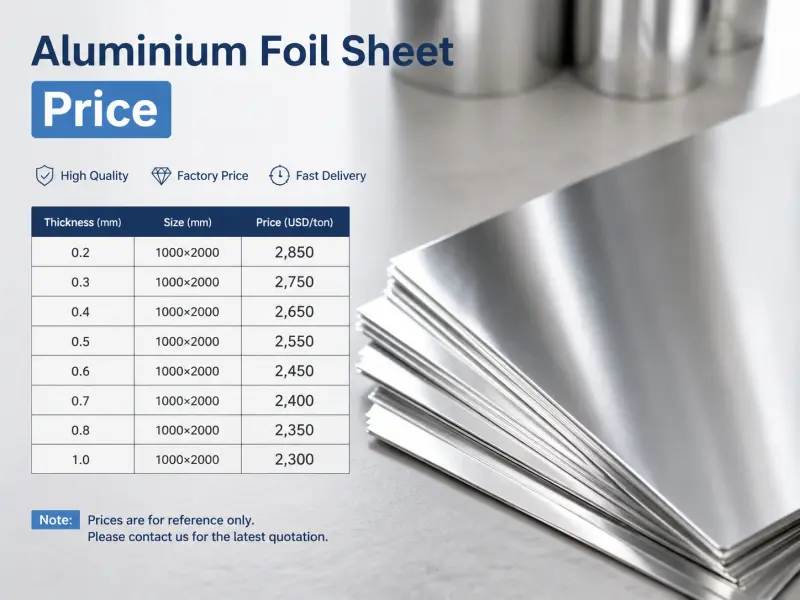
How Thickness Drives Price Per Ton
Thinner foil costs more per ton to produce. Each reduction in thickness requires additional rolling passes, tighter tension control, and higher reject risk.
| Thickness Range | Premium vs Standard Sheet (3003, 1.5mm) |
|---|---|
| 3.0mm – 6.0mm plate | Base |
| 0.5mm – 2.9mm sheet | +5–15% |
| 0.1mm – 0.4mm light gauge | +20–40% |
| 0.02mm – 0.09mm standard foil | +60–100% |
| 0.006mm – 0.019mm ultra-thin foil | +120–200% |
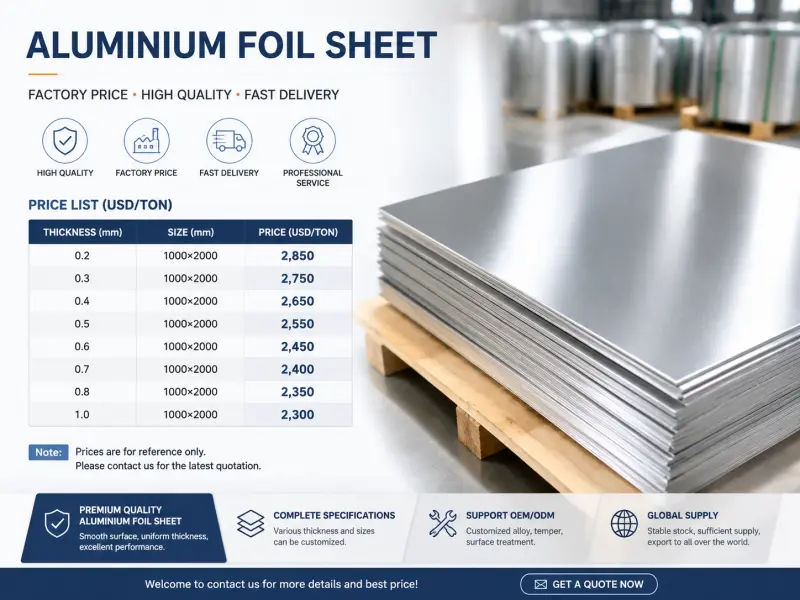
Aluminium Foil Grades and Price Ranges — 2024–2025 Reference
Different foil grades carry different premiums above LME. Here is a practical price reference for mill direct orders at 5-ton+ volumes.
Household and Food Foil
| Alloy | Temper | Thickness | Price /ton (USD) | Common Use |
|---|---|---|---|---|
| 8011-O | O | 0.009–0.015mm | 3,200–3,800 | Kitchen wrap, food packaging |
| 1235-O | O | 0.009–0.012mm | 3,300–3,900 | Food wrap, light packaging |
| 8011-O | O | 0.015–0.025mm | 3,000–3,600 | Container foil, semi-rigid |
Pharmaceutical and Medical Foil
| Alloy | Temper | Thickness | Price /ton (USD) | Use |
|---|---|---|---|---|
| 8011-O | O | 0.016–0.025mm | 3,400–4,100 | Blister packaging |
| 1235-O | O | 0.016–0.020mm | 3,500–4,200 | Strip packs, sachet |
| 8079-O | O | 0.018–0.030mm | 3,400–4,000 | Lidding foil |
Flexible Packaging and Lamination Foil
| Alloy | Temper | Thickness | Price /ton (USD) | Use |
|---|---|---|---|---|
| 8079-O | O | 0.006–0.009mm | 3,600–4,500 | Laminate pouches, sachets |
| 1235-O | O | 0.006–0.007mm | 3,800–4,700 | Ultra-thin lamination |
| 8021-O | O | 0.020–0.040mm | 3,300–4,000 | Lidding, seal foil |
Battery and Technical Foil
| Alloy | Temper | Thickness | Price /ton (USD) | Use |
|---|---|---|---|---|
| 1235-O | O | 0.010–0.016mm | 3,800–4,800 | Li-ion battery current collector |
| 1060-O | O | 0.012–0.020mm | 3,700–4,500 | Battery anode foil |
| 1070-O | O | 0.005–0.008mm | 4,200–5,500 | Capacitor foil, ultra-pure |
Heat Exchanger Fin Stock
| Alloy | Temper | Thickness | Price /ton (USD) | Use |
|---|---|---|---|---|
| 1100-O | O | 0.05–0.12mm | 2,900–3,400 | AC unit fins, heat exchangers |
| 3003-O | O | 0.05–0.10mm | 3,000–3,500 | Hydrophilic fin stock |
| 4343/3003 clad | O | 0.08–0.15mm | 3,400–4,200 | Brazed heat exchanger |
Insulation and Construction Foil
| Alloy | Temper | Thickness | Price /ton (USD) | Use |
|---|---|---|---|---|
| 1235-O | O | 0.025–0.04mm | 3,000–3,600 | Building insulation facing |
| 8011-H14 | H14 | 0.03–0.06mm | 3,100–3,700 | HVAC duct insulation wrap |
| 1060-O | O | 0.04–0.08mm | 2,900–3,500 | Pipe insulation jacketing |

Types of Aluminium Foil Sheet — From Household to Industrial
Household Aluminium Foil
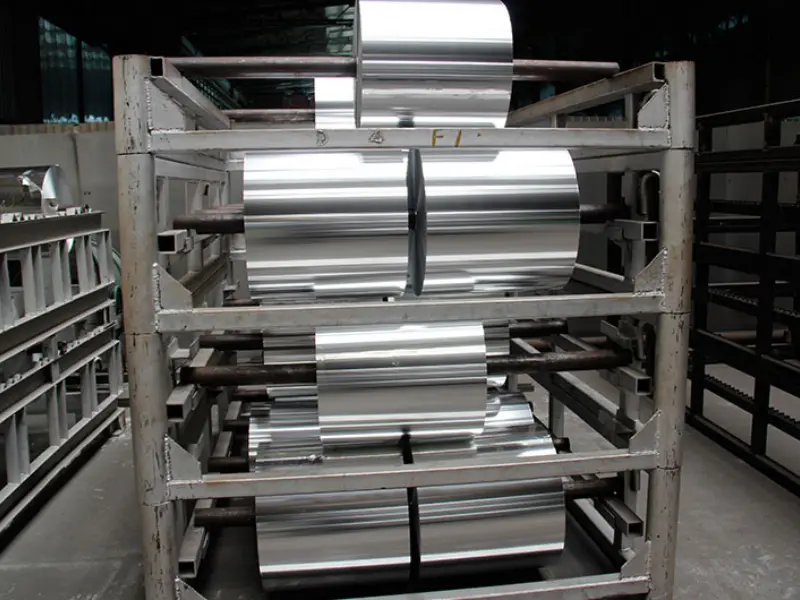
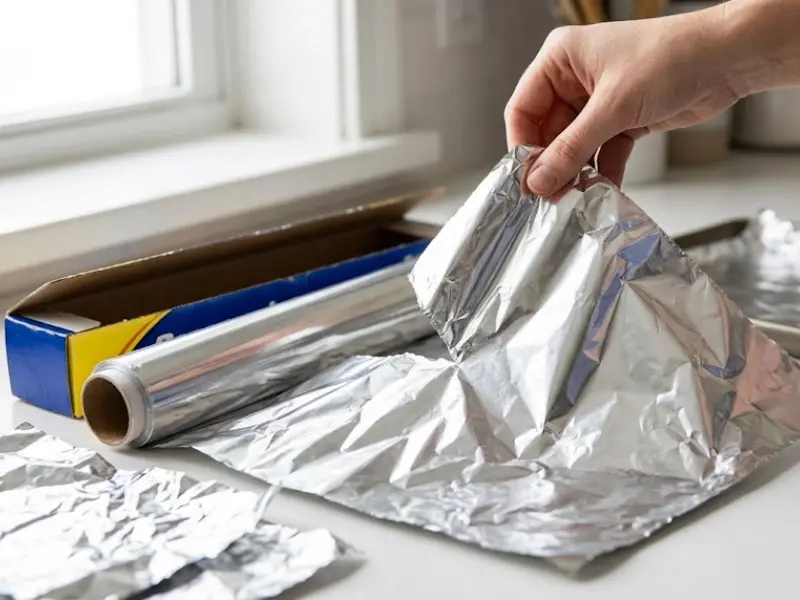
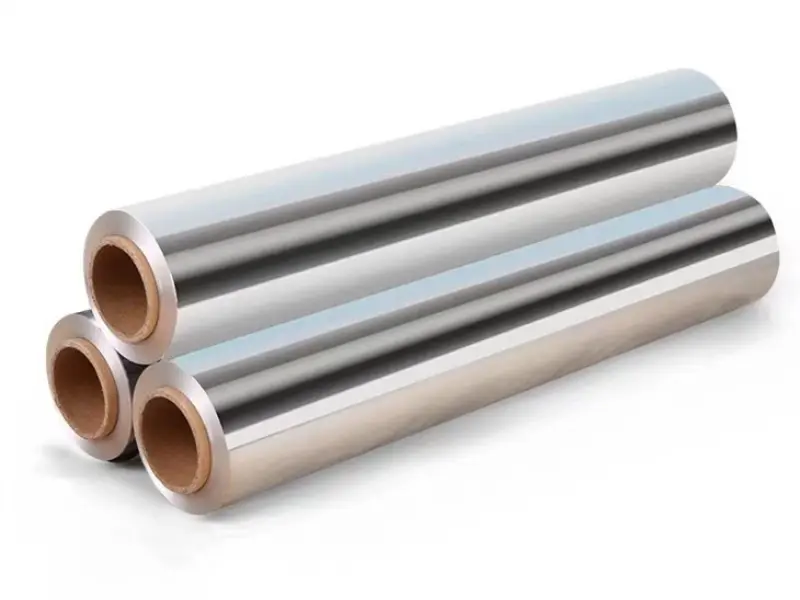
This is the most familiar product. Sold in retail rolls, made from 8011 or 1235 alloy in O temper, thickness ranges from 0.009mm to 0.02mm. It is light, flexible, and safe for food contact. The foil that households buy at grocery stores is typically pre-converted — cut to width, rolled, and packed into a dispensing box.
For industrial buyers, household foil is ordered in wide mill rolls (300–800mm wide) and converted in-house.
Price range at retail: USD 3–8 per 30-meter roll (100 sqm equivalent ~USD 10–25) Price at mill level (1-ton+): USD 3,200–3,800 per ton
Pharmaceutical Blister Foil
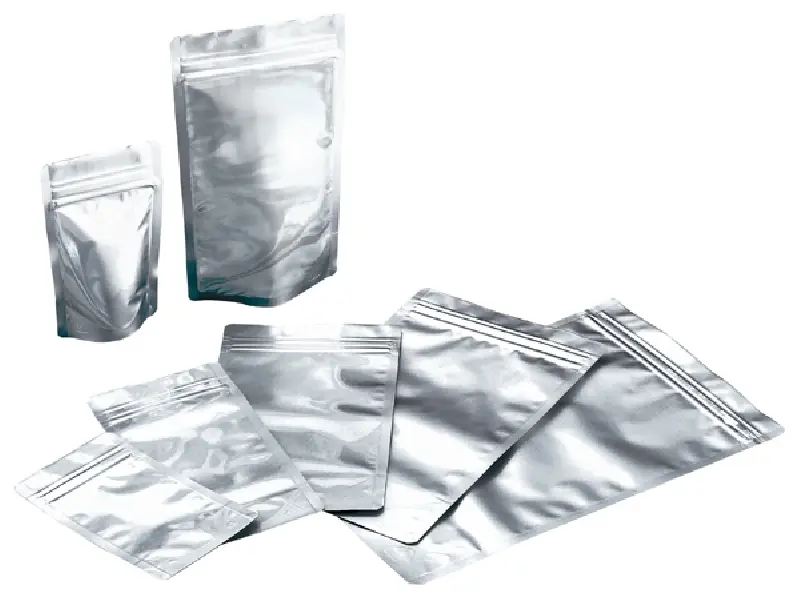
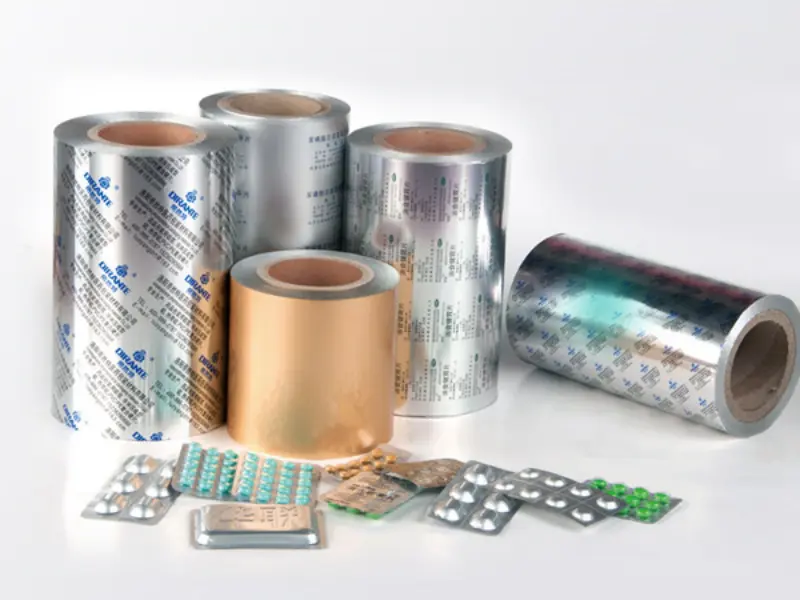
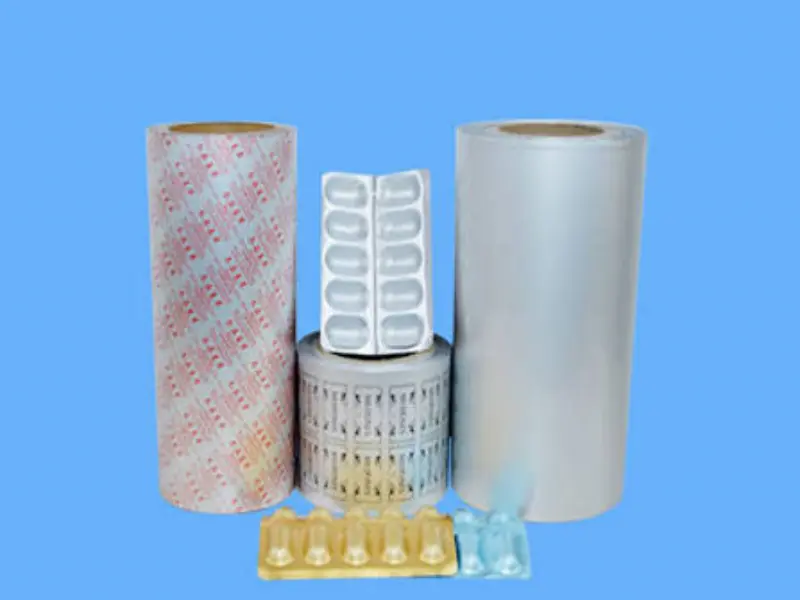
Used in blister packs for tablets and capsules. Alloy 8011 or 1235, O temper, 0.016–0.025mm. The foil must have zero pinholes — a single pinhole in pharmaceutical foil allows moisture through, degrading the drug. Quality testing is rigorous on this grade.
→ Zero pinhole count required → Lacquer or heat-seal coating applied on one face → Width tolerance tighter than household foil — typically ±0.3mm → Surface must be free of oil and particulates
Flexible Packaging Lamination Foil
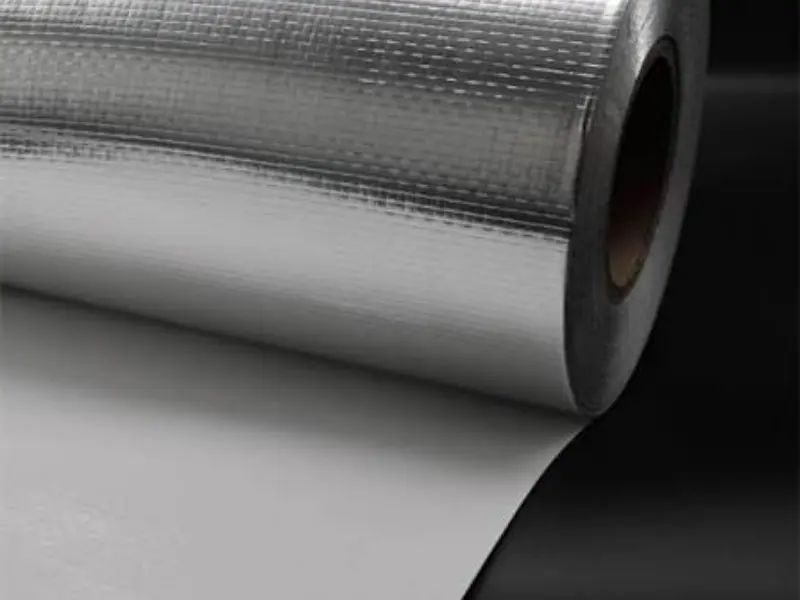
The thinnest technically demanding foil grade, running from 0.006mm to 0.009mm. It is laminated between plastic films and paper layers to form the barrier layer in sachets, stand-up pouches, coffee pods, and food laminate. At this thickness, the foil contains micro-pinholes — but the plastic lamination layers fill them, so barrier performance meets food-grade requirements.
Price for this grade runs USD 3,600–4,700 per ton depending on alloy and exact thickness.
Li-Ion Battery Current Collector Foil
One of the most technically demanding foil products. The foil must be extremely flat, have consistent thickness across the full width (typically ±5µm or tighter), and have low residual oil on the surface (below 5mg/m²). Any contamination or thickness deviation affects battery performance.
This is why battery foil commands the highest premium of any foil grade:
| Specification | Standard Foil | Battery Grade Foil |
|---|---|---|
| Alloy | 8011 | 1235, 1060 |
| Thickness | 0.009–0.025mm | 0.010–0.016mm |
| Thickness tolerance | ±0.001mm | ±0.0005mm |
| Surface oil | Standard | < 5mg/m² |
| Pinhole count | General | Zero acceptable |
| Price premium | Base | +20–35% above standard |
Heat Exchanger Fin Stock Foil
Fin stock is the thin foil that gets corrugated and brazed into heat exchangers for air conditioners, car radiators, and HVAC systems. The foil must form consistently without cracking, and in some grades carries a hydrophilic or hydrophobic coating to control condensation on the fin surface.
Thickness: 0.05–0.15mm — slightly thicker than ultra-thin foil Alloy: 1100, 3003, or clad products like 4343/3003
Container and Semi-Rigid Foil
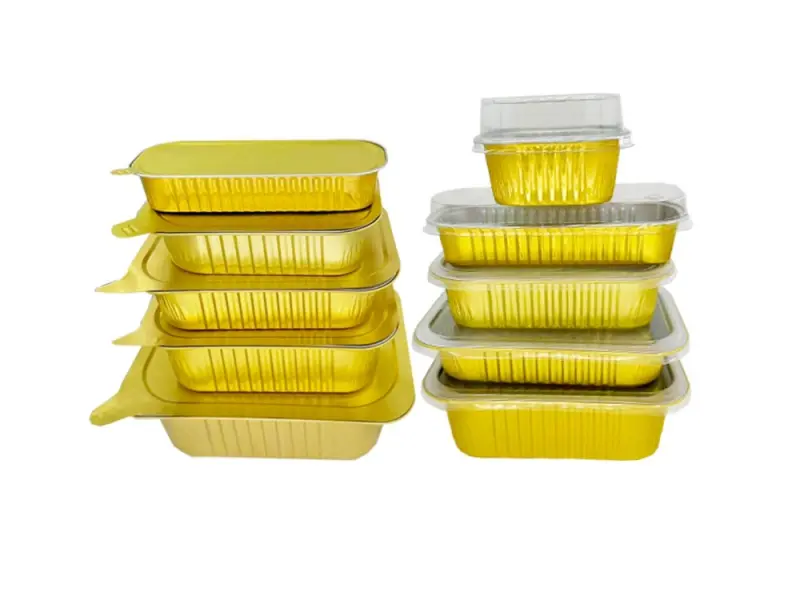
Thicker foil (0.04–0.2mm) formed into food containers, pie dishes, takeout trays, and baking pans. This sits at the thicker end of the foil range — stiff enough to hold its shape when formed but flexible enough to be crimped and folded. Alloy 8011 or 3003, O or H22 temper.
Price: USD 2,800–3,400 per ton at mill level
Capacitor Foil
The most demanding purity grade. Alloys 1070 and 1085 (99.7%+ and 99.85%+ Al) are used for electrolytic capacitor foil. The ultra-high purity enables a more consistent oxide film when anodized inside the capacitor. Thickness runs from 0.005mm to 0.08mm.
Price: USD 4,200–5,500 per ton — the highest foil price per ton due to purity and precision rolling requirements.
Price Comparison by Application Segment
| Application | Alloy | Thickness | Price /ton (USD) | Volume Trend |
|---|---|---|---|---|
| Household kitchen wrap | 8011-O | 0.009mm | 3,200–3,800 | Stable |
| Food container/tray | 8011-O | 0.05–0.08mm | 2,800–3,400 | Growing |
| Pharmaceutical blister | 8011-O | 0.020mm | 3,400–4,100 | Growing |
| Flexible packaging | 8079-O | 0.007mm | 3,600–4,500 | Fast growing |
| Battery current collector | 1235-O | 0.012mm | 3,800–4,800 | Fast growing (EV) |
| Heat exchanger fin | 3003-O | 0.08mm | 3,000–3,500 | Stable |
| Insulation facing | 1235-O | 0.03mm | 3,000–3,600 | Stable |
| Capacitor foil | 1070-O | 0.007mm | 4,200–5,500 | Growing |
What Moves the Price Between Suppliers
LME Spot Price — The Variable You Cannot Control
LME aluminium in mid-2025 trades in the USD 2,300–2,600 range per ton. Mill prices follow LME with a lag of days to weeks. For large orders, buyers can ask for a fixed LME reference date or request a price linked to a future LME average to reduce exposure to weekly swings.
Width and Tolerance — Narrow Strip Costs More
Standard wide coil (600–1600mm) is the cheapest form. Narrow slit strip (below 300mm) requires an extra slitting step after rolling, adding USD 50–150 per ton. Very narrow strip (below 50mm) for precision applications adds more.
Surface Treatment — Coated Foil Carries a Premium
| Surface | Extra Cost vs Plain Foil |
|---|---|
| Plain (no treatment) | Base |
| Lacquer one side | +USD 150–300/ton |
| Heat-seal coating | +USD 200–400/ton |
| Hydrophilic coating (fin stock) | +USD 300–500/ton |
| Anti-corrosion coating | +USD 200–350/ton |
Aluminium Foil Sheet Price Order Volume Impact
| Order Size | Price Level |
|---|---|
| < 1 ton | Retail / converter price |
| 1–5 tons | Distributor wholesale |
| 5–20 tons | Mill direct, standard |
| 20–50 tons | Mill direct, better tier |
| 50+ tons | Negotiated contract price |
Retail vs Wholesale vs Factory Direct — How Big Is the Gap
A household foil roll at a supermarket retails for USD 3–8 for a 30-meter roll. The same material at mill level costs approximately USD 3,200–3,800 per ton. Here is the conversion:
A 30-meter roll of 30cm wide, 0.012mm foil contains approximately:
- Volume: 0.3m × 30m × 0.000012m = 0.000108 m³
- Weight: 0.000108 × 2,710 = ~0.29 kg
At USD 3,500/ton mill price, that 0.29 kg of foil costs USD 1.02 at mill level. Retail price is USD 3–8. The retail markup covers converting (slitting, rolling, packing), brand, distribution, and retail margin.
For industrial buyers who convert foil themselves, buying at mill level versus buying converted roll cuts material cost by 60–80%.
Aluminium Foil Sheet Price Applications Across Industries
Food and Beverage Packaging
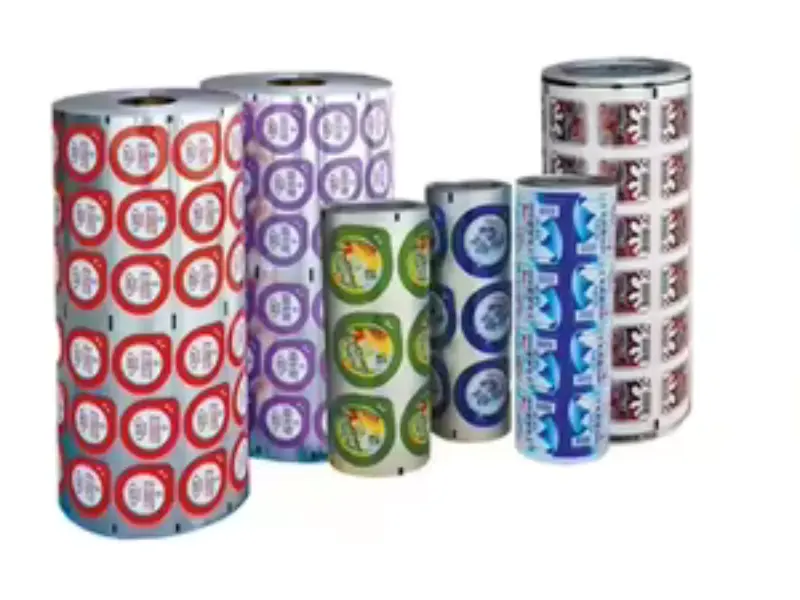
- Household kitchen foil for wrapping and cooking
- Ready-meal containers and takeaway trays
- Coffee pod bodies and lids
- Butter and margarine wrapping foil
- Cheese and cold-cut packaging
- Wine bottle neck foil and capsules
- Tea and coffee sachet lamination foil
Pharmaceutical and Healthcare
- Blister packaging for tablets and capsules
- Strip pack foil for single-dose medications
- Parenteral nutrition pouch lamination
- Medical device packaging foil
- Surgical supply sterile barrier foil
Energy and Electronics
- Li-ion battery anode current collector
- Supercapacitor foil (high-purity grades)
- Electrolytic capacitor etching foil
- Solar panel backsheet component
- EV battery pouch cell lamination foil
HVAC and Refrigeration
- Air conditioner evaporator and condenser fins
- Automotive radiator fin stock
- Refrigerator and freezer heat exchanger fins
- Industrial heat recovery unit fins
- Hydrophilic coated fin stock for dehumidification
Building and Insulation
- Pipe and duct insulation facing foil
- Thermal building wrap barrier layer
- Underfloor heating reflective layer
- Roof membrane reflective facing
- HVAC flexible duct outer wrap
Electrical and Cable
- Power transformer winding foil (1060, 1070)
- Cable shielding and wrapping strip
- Electrical capacitor internal foil
Aluminium Foil vs Other Packaging Materials — Why Price Comparison Matters
Aluminium Foil vs Plastic Film
| Feature | Aluminium Foil | Plastic Film (PET/PE) |
|---|---|---|
| Gas barrier | Excellent | Moderate |
| Moisture barrier | Excellent | Good |
| Heat resistance | Excellent | Limited |
| Recyclability | Yes | Varies |
| Cost per m² | Higher | Lower |
| Shelf life of packed product | Extended | Shorter |
For products requiring long shelf life or high barrier performance, aluminium foil justifies its higher cost through significantly better protection.
Aluminium Foil vs Steel Foil (Tinplate)
| Feature | Aluminium Foil | Tinplate |
|---|---|---|
| Weight | ~2.7 g/cm³ | ~7.85 g/cm³ |
| Corrosion resistance | Excellent | Requires tin coating |
| Formability | Excellent | Good |
| Recyclability | Yes — high value | Yes |
| Cost | Competitive | Higher per equivalent weight |
| Typical use | Flexible packaging | Rigid cans, closures |
How to Get the Best Price on Aluminium Foil Sheet
Five Ways to Reduce Cost Per Ton
→ Match thickness to need — do not over-specify gauge. Thinner foil costs more. If your application works at 0.012mm, do not buy 0.009mm.
→ Order wide coil and convert in-house — buying pre-slit narrow widths adds 5–15% cost. If you have slitting capability, order full-width coil.
→ Consolidate orders — combine different widths and thicknesses into one shipment to reach better price tiers.
→ Use standard alloys — 8011 and 1235 are the most produced and most competitively priced foil alloys. Non-standard alloys carry small premiums.
→ Frame agreements — quarterly or annual volume commitments with a mill allow you to lock a fixed premium above LME. This removes price exposure on long-running production contracts.
Buying Aluminium Foil from China — What to Know
China produces the majority of global aluminium foil, including household, pharmaceutical, flexible packaging, and battery grades. Factory direct pricing from Chinese mills runs 20–35% below comparable European or North American converter pricing for the same specification.
Specifications to Confirm Before Ordering
| Item | Details to Confirm |
|---|---|
| Alloy | 8011, 1235, 8079, 1060 |
| Temper | O for most foil grades |
| Thickness | Nominal ± tolerance (e.g. 0.012mm ± 0.001mm) |
| Width | Standard or custom slit |
| Coil OD / ID | Match to your unwinding equipment |
| Surface | Plain, lacquered, heat-seal coated |
| Pinhole spec | Per m² maximum count |
| MTR required | Yes — ASTM B479 or EN 546 |
Lead Time from Chinese Mills
| Foil Type | Production Time | Sea Transit |
|---|---|---|
| Household / food foil | 10–20 days | 18–40 days |
| Pharmaceutical foil | 15–25 days | 18–40 days |
| Battery foil | 20–35 days | 18–40 days |
| Fin stock | 15–25 days | 18–40 days |
Aluminium Foil Sheet Price Frequently Asked Questions
What Is the Current Price of Aluminium Foil Per Ton
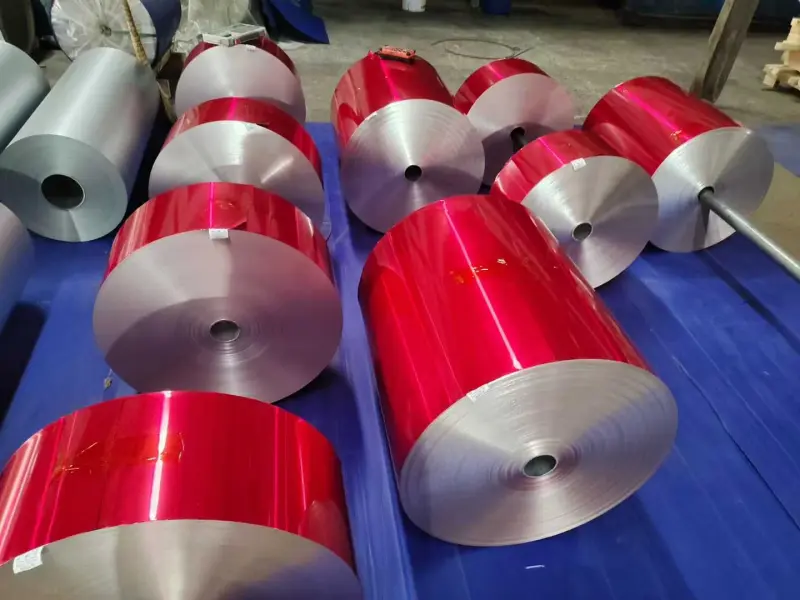
In mid-2025, standard household foil grade (8011-O, 0.012mm) from Chinese mills runs approximately USD 3,200–3,800 per ton for 5-ton+ orders. Pharmaceutical foil adds 10–20% to that range. Battery-grade foil runs USD 3,800–4,800 per ton. Capacitor foil reaches USD 4,200–5,500. All prices move with weekly LME aluminium spot pricing.
Why Is Thinner Foil More Expensive Per Ton
Thinner foil requires more rolling passes, tighter mill control, and slower production speed. Reject rates are also higher at ultra-thin gauges — any defect in the foil strip causes a wider section to be scrapped. These production factors add a conversion premium that grows as thickness decreases. A 0.006mm lamination foil costs roughly twice per ton what a 0.05mm fin stock foil costs, even though the alloy is similar.
What Is the Difference Between 8011 and 1235 Foil
Both are standard food-grade foil alloys but with different compositions. 8011 contains iron and silicon additions that improve rolling performance at thin gauges. 1235 is purer (99.35% Al minimum) and gives a brighter surface. 1235 is more common in high-clarity packaging applications. 8011 is more common in household and food container foil where surface brightness matters less than rolling efficiency.
Can Aluminium Foil Sheet Be Custom Cut to Width
Yes. Any mill with a slitting line can cut wide foil coil to a specific width. Standard slit widths start at around 30mm and go up to the full coil width (typically 600–1600mm). Width tolerance on precision slit foil is typically ±0.3–0.5mm. Narrower slit widths add a slitting cost of USD 50–150 per ton.
What Minimum Order Is Typical for Foil from a Chinese Manufacturer
For standard household and food foil grades, MOQ is typically 3–5 tons per specification (alloy, temper, thickness, width). For pharmaceutical-grade foil with coating, MOQ may be 5–10 tons due to the coating line setup cost. Battery foil MOQ runs 5–10 tons due to the precision rolling involved. Some trading companies accept 1–2 ton mixed orders at a higher unit price.
Final Notes for Foil Buyers
Aluminium foil sheet price has more moving parts than most other aluminum products. The LME base you cannot control. The conversion premium is determined by your thickness specification — and that is the lever buyers most often overlook. Moving from 0.009mm to 0.012mm on a household application cuts conversion cost meaningfully and the product performs the same.
For food and packaging foil: 8011-O at 0.012–0.015mm is the right starting spec for most applications.
For pharmaceutical blister: 8011-O at 0.020mm, zero pinhole, one-side lacquered — verify the pinhole count specification in writing.
For battery foil: 1235-O at 0.012–0.016mm — surface cleanliness and thickness uniformity are non-negotiable; get the full QC spec in writing before ordering.
Request a mill test report and sample coil before committing to large volumes. For ongoing production, a frame agreement with fixed LME premium is worth the negotiation time.