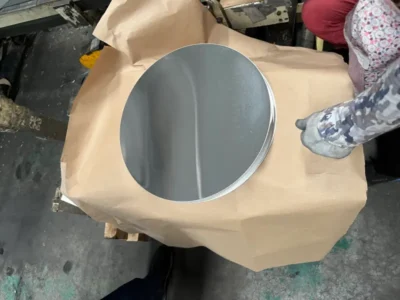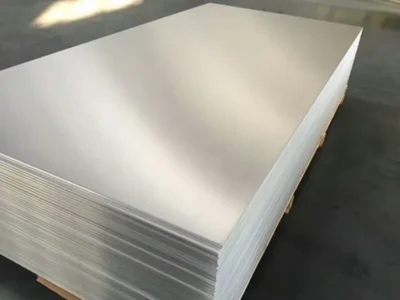
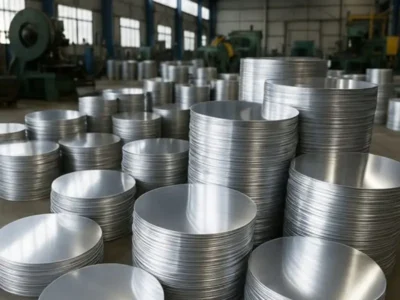
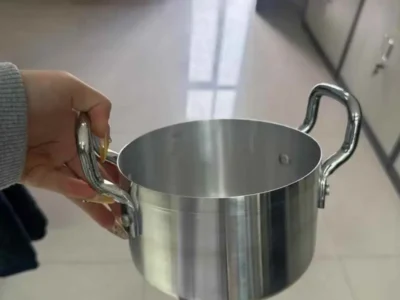
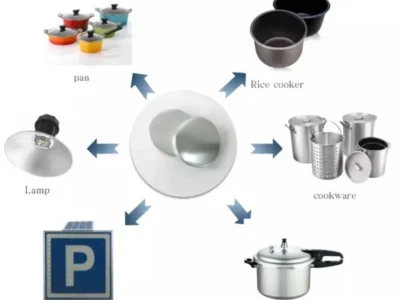
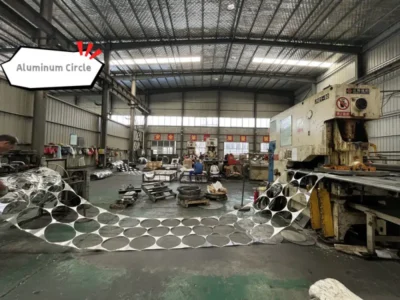
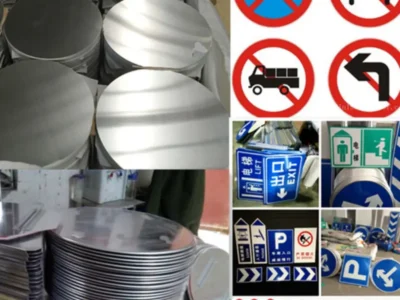
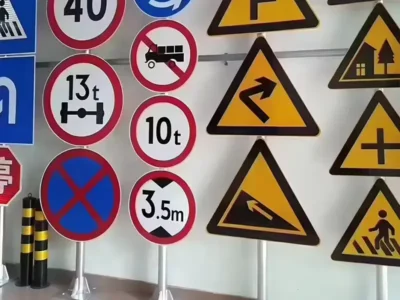
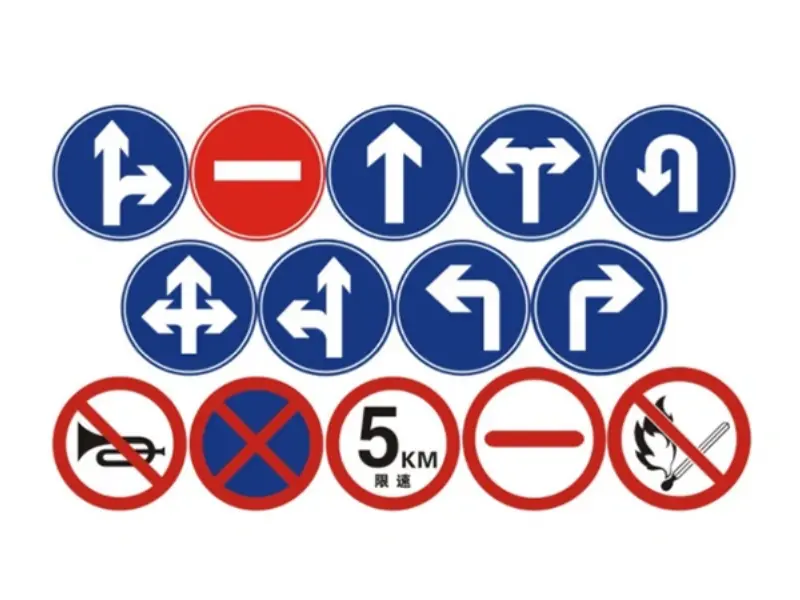
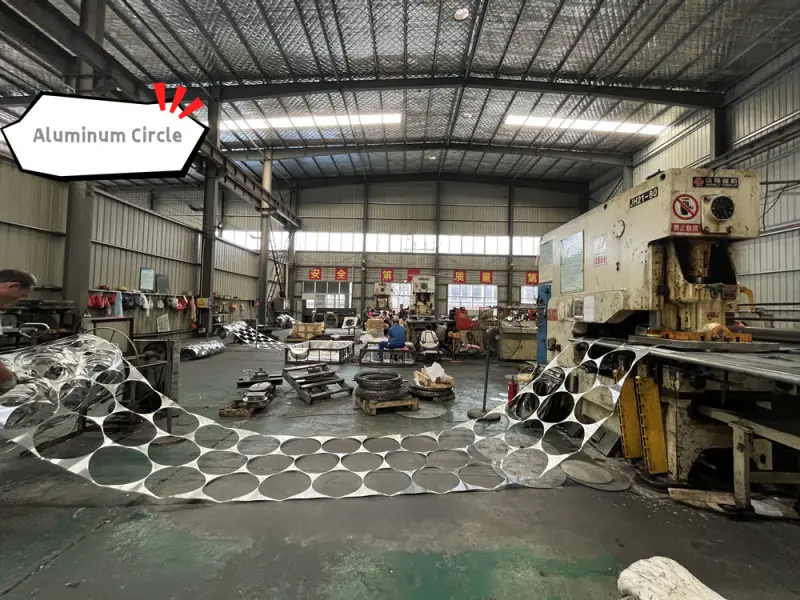
Aluminum circles — also called aluminum discs or round blanks — are flat, pre-cut pieces of aluminum sheet in a circular shape. They come in a wide range of diameters, thicknesses, and alloys. Manufacturers use them as the starting point for pots, pans, road signs, lamp shades, bottle caps, and dozens of other products.
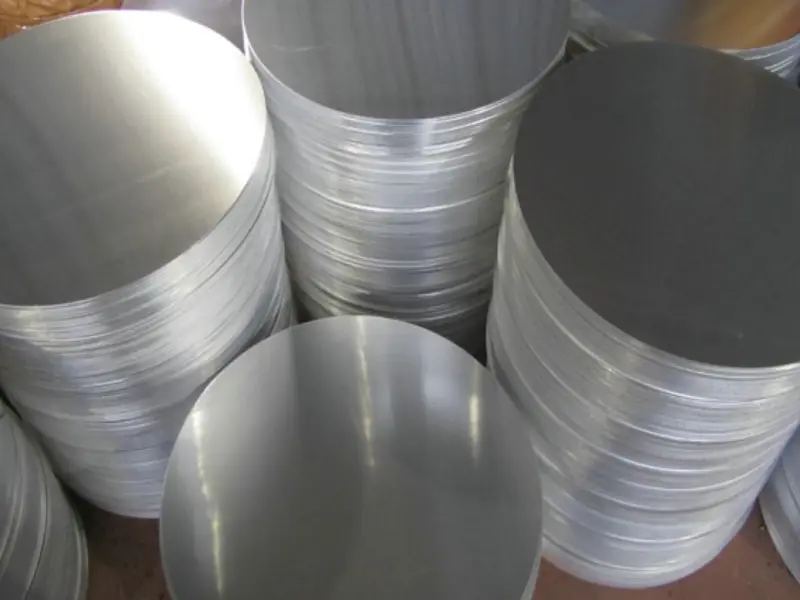
Buying pre-cut circles saves time and reduces scrap compared to cutting circles from rectangular sheet. Most suppliers offer standard sizes and can also cut custom diameters on request.
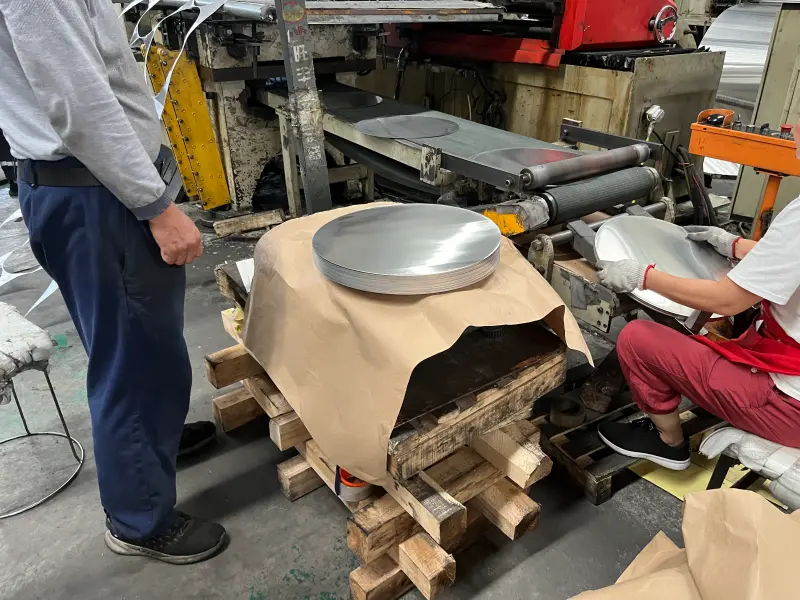
Key specs at a glance:
| Parameter | Range |
|---|---|
| Diameter | 50 – 1500 mm |
| Thickness | 0.3 – 6.0 mm |
| Alloys | 1050 · 1060 · 1100 · 3003 · 5052 |
| Temper | O · H12 · H14 · H24 · H32 |
| Surface | Mill · Brushed · Anodized · Color-Coated |
| Diameter Tolerance | ±0.5 mm (standard) |
Alloy by Alloy — Which One Fits Your Job?
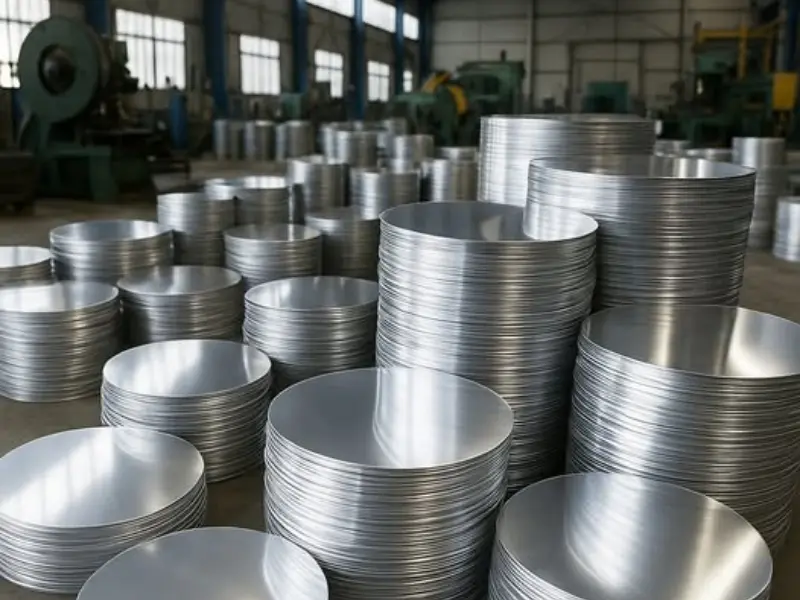
Most aluminum circles fall into the 1xxx or 3xxx series. Each series has a different balance of formability, strength, and corrosion resistance.
| Alloy | Main Element | Strength | Formability | Corrosion Resistance | Primary Use |
|---|---|---|---|---|---|
| 1050 | Pure Al (≥99.5%) | Low | Excellent | Excellent | Cookware, lamp reflectors |
| 1060 | Pure Al (≥99.6%) | Low | Excellent | Excellent | Deep-drawn parts, chemical equipment |
| 1100 | Pure Al (≥99.0%) | Low–Med | Very Good | Excellent | Nameplates, decorative discs, food contact |
| 3003 | Manganese | Medium | Good | Very Good | Pressure cookers, road signs, caps |
| 3004 | Mn + Mg | Med–High | Moderate | Very Good | Beverage cans, deep-drawn housings |
| 5052 | Magnesium | High | Moderate | Excellent | Marine discs, traffic signs, structural parts |
1050 & 1060 — The Cookware Standard
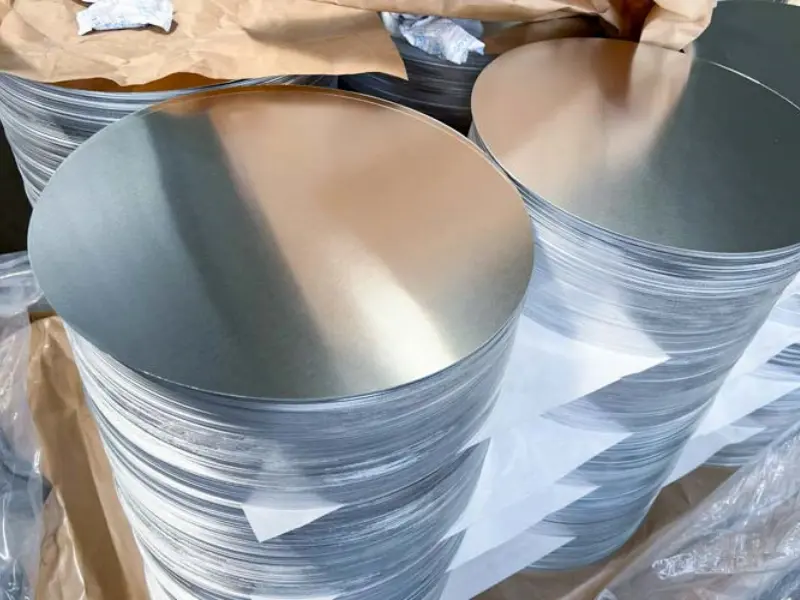
These two grades are the most popular for kitchen cookware. High purity means excellent heat conductivity and easy deep drawing. They spin, stamp, and press without cracking. Most wok and pot blanks on the market use 1050-O or 1060-O.
3003 — The All-Rounder
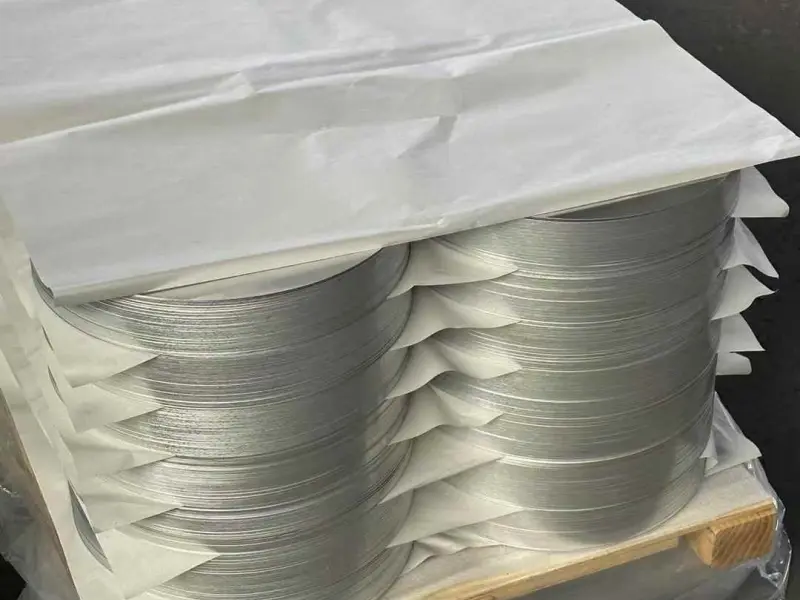
Adding manganese raises strength by about 20% over 1100 without hurting workability much. 3003 circles are widely used for pressure cookers, road disc markers, and bottle closures. If you need a bit more stiffness than 1050 offers, 3003 is the next step up.
5052 — For Tough Environments
The highest corrosion resistance of the group. Magnesium content makes 5052 circles a good fit for marine parts, outdoor sign discs, and applications near salt or chemicals. It is harder to deep-draw than 1050 but holds up far better in harsh conditions.
Temper Codes Explained
The letter-number after the alloy tells you the hardness state. For aluminum circles, the temper affects how well the blank draws, spins, or stamps.
| Temper | State | Hardness | Formability | Typical Circle Use |
|---|---|---|---|---|
| O | Fully annealed, softest | Lowest | Best | Deep-drawn pots, pans, woks, lamp shades |
| H12 | Strain-hardened, quarter-hard | Low–Med | Good | Shallow-drawn lids, disc signs |
| H14 | Strain-hardened, half-hard | Medium | Moderate | Flat sign discs, engraving blanks |
| H24 | Strain-hardened + partial anneal | Medium | Moderate | Spinning discs, curved lamp parts |
| H32 | Strain-hardened (5xxx series) | Med–High | Lower | Marine discs, outdoor sign circles (5052) |
Tip: For cookware, always specify O temper. Deep drawing requires maximum ductility — any strain hardening increases the risk of cracking at the rim during forming.
Diameter & Thickness — Standard Ranges
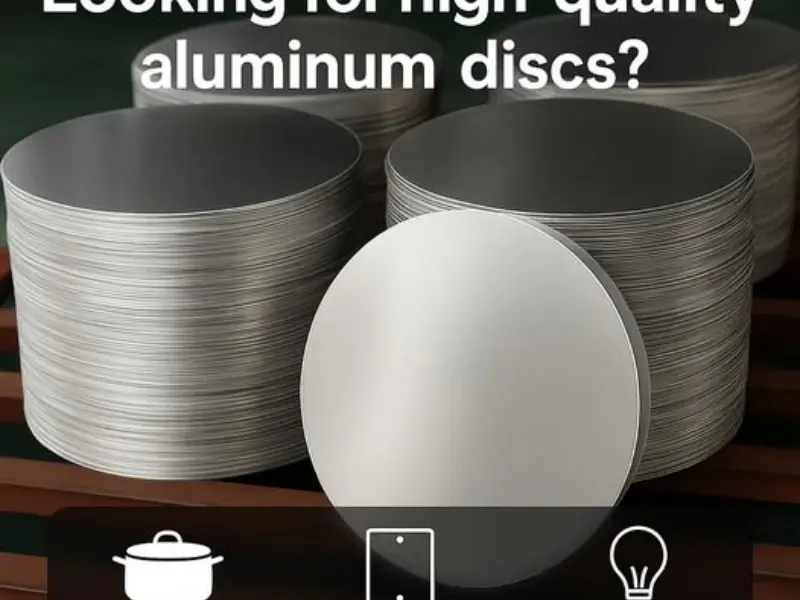
Most mills stock circles in set diameter steps. Custom diameters are available with a minimum order quantity.
Standard Diameter Steps
| Diameter Range (mm) | Common Steps (mm) | Typical End Product |
|---|---|---|
| 50 – 150 | 50, 80, 100, 120, 150 | Bottle caps, small lids, disc connectors |
| 150 – 300 | 160, 180, 200, 240, 260, 300 | Small pots, sauce pans, bowls |
| 300 – 500 | 320, 360, 400, 450, 500 | Woks, frying pans, pressure cooker blanks |
| 500 – 800 | 550, 600, 700, 800 | Large pots, lamp reflectors, sign discs |
| 800 – 1500 | 900, 1000, 1200, 1500 | Industrial lids, road reflector bases, tank tops |
Thickness vs. Application
| Thickness (mm) | Weight (kg/m²) | Use Case | Notes |
|---|---|---|---|
| 0.3 – 0.5 | 0.81 – 1.35 | Bottle caps, foil-type closures | Very thin; needs smooth tooling |
| 0.6 – 0.8 | 1.62 – 2.16 | Shallow lids, disc labels, decorative panels | Light; easy to stamp |
| 1.0 – 1.5 | 2.70 – 4.05 | Pots, pans, lamp shades, sign discs | Most popular cookware range |
| 2.0 – 3.0 | 5.40 – 8.10 | Pressure cookers, thick-base pans, traffic discs | Good stiffness; slower to draw |
| 4.0 – 6.0 | 10.8 – 16.2 | Industrial lids, heavy-duty sign blanks | Usually flat-use only; not deep-drawn |
Product Types — More Than Just a Round Piece
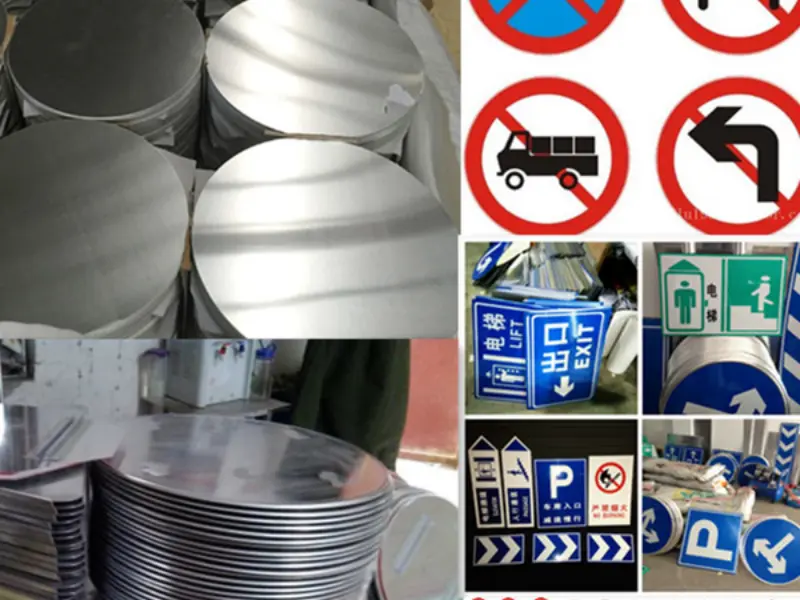
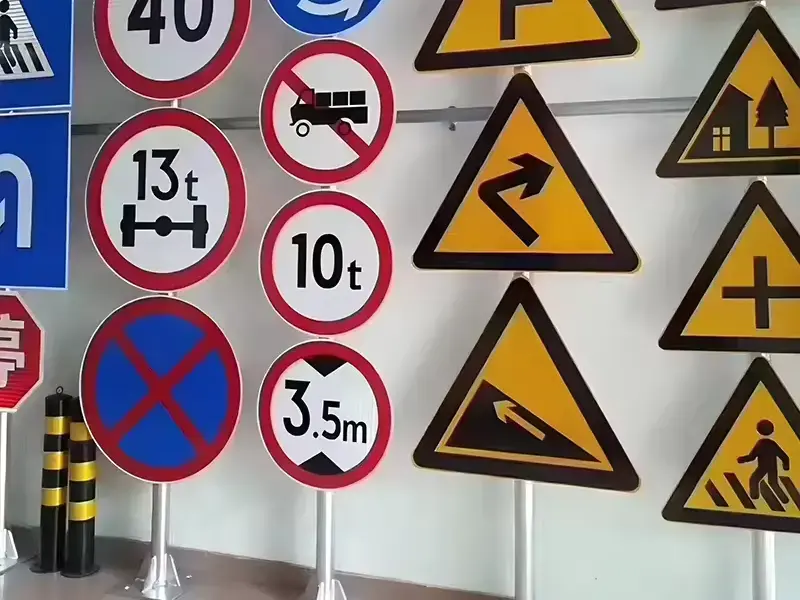
Aluminum circles come in several finished forms. The right type depends on what processing step comes next in your production line.
Mill-Finish Circles Standard surface straight from the rolling mill. Ready for stamping, spinning, or painting. The most economical option and the most widely ordered type globally.
Anodized Circles Electrochemically oxidized surface. Hard, scratch-resistant, available in silver, black, and gold tones. Popular for cookware exteriors, decorative discs, and outdoor sign applications where long service life matters.
Brushed Circles Mechanically abraded for a satin linear finish. Used for instrument panels, decorative sign discs, and premium cookware lids. The texture hides minor scratches well in daily use.
Color-Coated Circles Pre-painted with polyester or PVDF coating before shipment. Available in RAL colors. Cuts fabrication steps for manufacturers who need consistent color without an in-house painting line.
Non-Stick Coated Circles PTFE or ceramic non-stick layer applied to the blank before forming. Reduces post-production coating steps for cookware factories. The coating must be able to withstand the forming process without cracking.
Polished / Bright-Rolled Circles Highly reflective surface achieved by bright rolling or mechanical polishing. Used for lamp reflectors, solar concentrator components, and mirror-effect decorative parts.
Surface Finish Side by Side
| Finish | Appearance | Scratch Resistance | Food Safe? | UV Stability | Cost Level |
|---|---|---|---|---|---|
| Mill Finish | Dull silver | Low | Yes (food-grade alloy) | Moderate | $ |
| Brushed | Satin linear | Medium | Yes | Good | $$ |
| Anodized (clear) | Bright silver | High | Yes | Excellent | $$ |
| Anodized (color) | Black / gold / bronze | High | Depends on dye | Excellent | $$$ |
| PVDF Paint | Any RAL color | Med–High | Not typical | Excellent | $$$ |
| Non-Stick (PTFE) | Dark matte | Medium | Yes (FDA-grade) | Good | $$$ |
Aluminum Circles for Cookware — A Closer Look
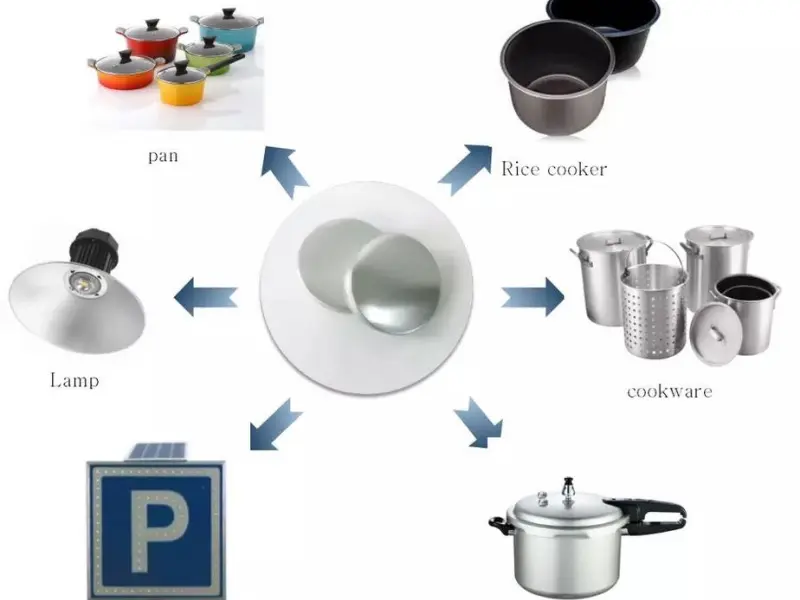
Cookware is the single largest end-use market for aluminum circles. The forming process, alloy choice, and thickness all affect how the finished pot or pan performs.
Why Aluminum Works Well for Cookware
- Thermal conductivity of about 200 W/m·K — heats evenly and quickly
- Low density (2.7 g/cm³) — pans stay light for everyday use
- Easy to deep draw into complex shapes without tearing
- Takes non-stick coatings well after surface preparation
- Lower cost than stainless steel or copper alternatives
Cookware Circle Spec at a Glance
| Product | Alloy | Temper | Diameter (mm) | Thickness (mm) |
|---|---|---|---|---|
| Frying pan | 1050 / 1060 | O | 220 – 320 | 1.5 – 3.0 |
| Sauce pan | 1050 / 3003 | O | 160 – 240 | 1.2 – 2.5 |
| Wok | 1060 | O | 360 – 500 | 1.5 – 2.5 |
| Pressure cooker | 3003 | O | 220 – 320 | 2.0 – 3.0 |
| Stock pot | 1050 / 1060 | O | 280 – 400 | 1.5 – 2.5 |
| Pan lid | 1050 / 3003 | H12 | 180 – 340 | 1.0 – 1.5 |
Induction Compatibility
Pure aluminum is not magnetic and does not work on induction hobs by itself. Cookware makers solve this by bonding a stainless steel or magnetic base layer to the aluminum circle before forming. If your pans need induction compatibility, specify a clad circle (aluminum + stainless sandwich).
Where Aluminum Circles Are Used
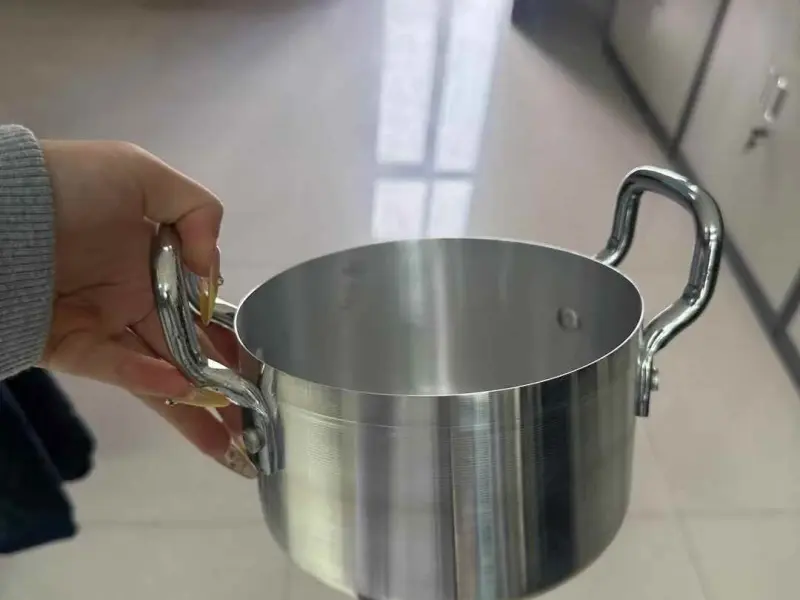
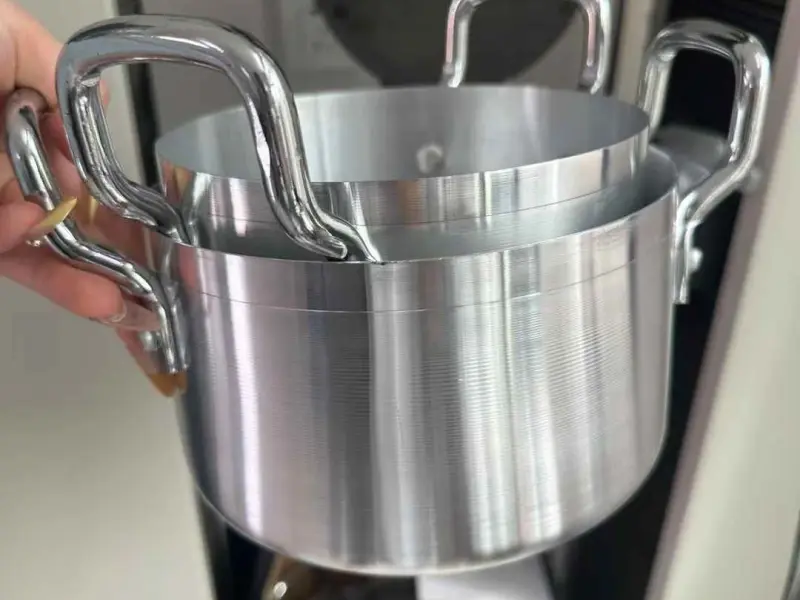
The cookware industry is the largest buyer, but aluminum circles show up in many other sectors.
- Frying pans & woks
- Pressure cooker bodies
- Lamp shades & light reflectors
- Road traffic disc markers
- Bottle & container caps
- Speaker cone blanks
- Mechanical disc components
- Solar reflector panels
- Engraving & ID discs
- Marine hatch covers
- Decorative ceiling medallions
- Battery heat-shield discs
Industry Breakdown
| Industry | Typical Alloy | Thickness (mm) | Key Requirement |
|---|---|---|---|
| Cookware | 1050 / 1060 | 1.5 – 3.0 | Deep-draw formability, food safety |
| Lighting | 1050 / 1100 | 0.5 – 1.5 | High reflectivity, smooth surface |
| Traffic / Road Signs | 3003 / 5052 | 1.5 – 3.0 | Outdoor durability, flatness |
| Packaging / Caps | 1050 / 3004 | 0.3 – 0.8 | Very thin, consistent gauge |
| Automotive / EV | 3003 / 5052 | 1.0 – 3.0 | Lightweight, heat resistance |
| Decorative | 1100 / 3003 | 0.5 – 2.0 | Surface finish, tight tolerance |
Custom Sizes — What to Specify
Standard stock circles cover the most common diameters. For anything outside the standard range, most mills accept custom orders.
Information Needed for a Custom Quote
- Diameter — specify in mm; state the tolerance you need (±0.5 mm is typical)
- Thickness — in mm; include thickness tolerance if critical
- Alloy and temper — e.g., 1050-O or 3003-H14
- Surface finish — mill finish, brushed, anodized, or painted
- Quantity — most custom sizes have a minimum order of 500–1,000 kg
- Edge condition — sheared edge (standard) or deburred edge (cleaner, slightly higher cost)
Lead time: Standard sizes ship within 3–7 days. Custom diameters typically require 10–20 business days depending on mill schedule and surface treatment.
Tolerance Reference
| Parameter | Standard Tolerance | Tight Tolerance (on request) |
|---|---|---|
| Diameter | ±0.5 mm | ±0.2 mm |
| Thickness | ±0.05 mm (thin) / ±0.1 mm (thick) | ±0.03 mm |
| Flatness | ≤3 mm/m | ≤1.5 mm/m |
| Edge burr height | ≤0.1 mm | ≤0.05 mm (deburred) |
Frequently Asked Questions
Are aluminum circles safe for cookware?
Alloy Matters Yes — but the alloy must be a food-grade grade. 1050, 1060, and 1100 are all food-safe. They have very low levels of other elements and pass food-contact regulations in the EU and US.
Coating Consideration Bare aluminum can react slowly with acidic foods over time. Most cookware is anodized or coated with a non-stick layer to prevent direct contact between raw aluminum and food.
What is the difference between 1050 and 3003 for cookware?
1050 — Softer, Better for Deep Drawing Higher purity means better thermal conductivity and easier forming. Most frying pans and woks use 1050 or 1060. The tradeoff is lower strength — it dents more easily than 3003.
3003 — Stronger, Better for Pressure Use About 20% stronger than 1050. Preferred for pressure cookers and thick-base pans. Slightly harder to deep-draw, so tooling must be in good condition.
Can I order aluminum circles in custom diameters?
Yes, With a Minimum Quantity Custom diameters between 50 mm and 1500 mm are available from most suppliers. Standard tolerance is ±0.5 mm on diameter. Most mills require a minimum of 500–1,000 kg per custom size.
Faster Option If your required size is close to a standard step, ask the supplier about trimming stock circles down. It is often faster and cheaper than a full custom mill run for small quantities.
What temper should I use for spinning or stamping?
O Temper for Deep Drawing and Spinning Fully annealed O temper gives maximum ductility. It is the standard choice for deep-drawn pots, pans, and spun lamp shades. It draws without cracking at the rim.
H12 or H14 for Flat Sign Discs If the circle will not be formed — for example, a flat sign disc or engraving blank — H14 gives better flatness and stiffness straight from the mill.
How are aluminum circles cut from sheet?
Blanking Press (Most Common) A punch and die cut the circle from coil or sheet in one stroke. Fast, accurate, and economical for high volumes. Typical tolerance is ±0.3–0.5 mm on diameter.
Laser Cutting Better for thick plates (3 mm+) or complex edge profiles. Slower and more expensive per piece but gives a clean edge. Used for structural or decorative discs where edge quality matters.
Waterjet Cutting No heat input — good for thick aluminum where laser might cause distortion. Used for custom or low-volume orders.
What surface treatment is best for outdoor aluminum discs?
Anodizing Creates a hard oxide layer that is part of the metal — it cannot peel. Best for long-term outdoor use. Clear anodize on 5052 gives excellent corrosion resistance.
PVDF Paint Available in any RAL color. UV-stable for 20+ years. Preferred for outdoor sign discs and architectural parts where color consistency matters over a long service life.