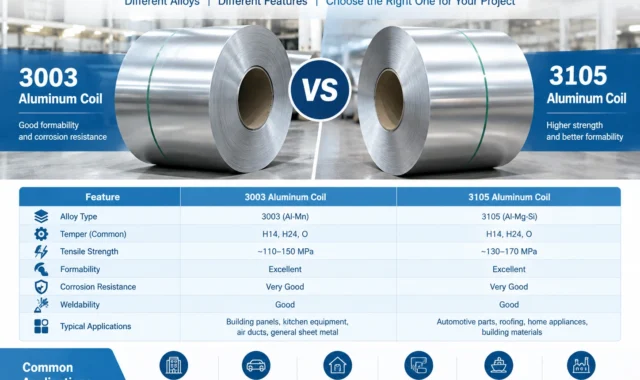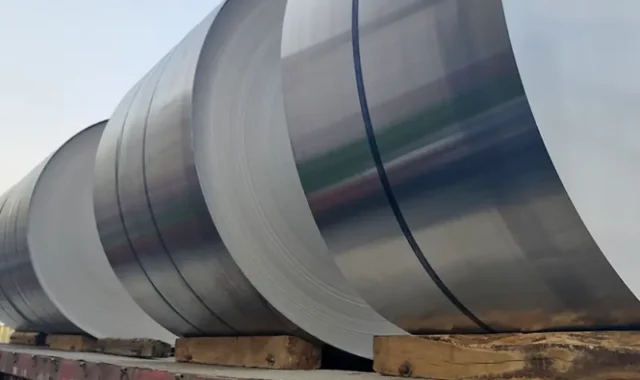
The aluminum sheet weight chart helps customers quickly understand the weight of aluminum sheets before purchasing, shipping, and processing.
Aluminum sheet weight depends on several factors:
→ Aluminum alloy type
→ Sheet thickness
→ Sheet width and length
→ Density of aluminum material
→ Surface treatment
Because aluminum sheets are used in construction, transportation, machinery, decoration, and industrial projects, accurate weight calculation is important for cost control and structural design.
A professional aluminum supplier can provide different sizes, thicknesses, and alloys according to project requirements.
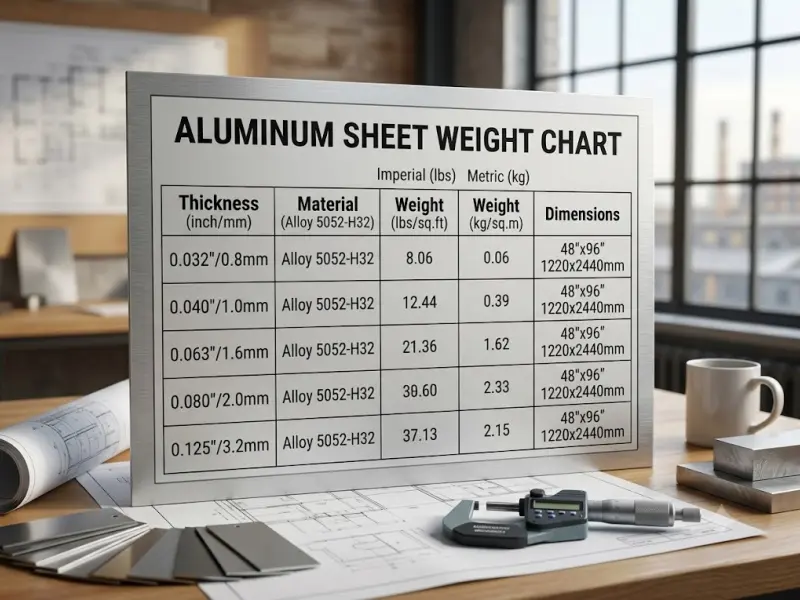
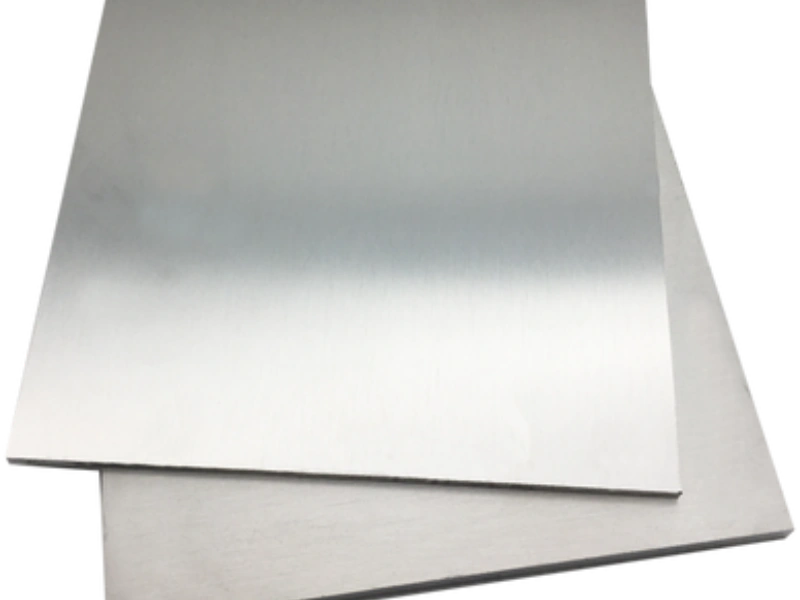
How to Calculate Aluminum Sheet Weight?
The weight of aluminum sheet can be calculated by the following formula:
Weight = Length × Width × Thickness × Density
The standard density of aluminum is about:
2.71 g/cm³
For practical calculation:
| Item | Unit |
|---|---|
| Length | mm |
| Width | mm |
| Thickness | mm |
| Density | 2.71 |
| Weight | kg |
Example:
A 1mm thick aluminum sheet:
Size:
1000 mm × 2000 mm × 1 mm
Approximate weight:
≈ 5.42 kg
The actual weight may vary slightly depending on alloy and manufacturing tolerance.
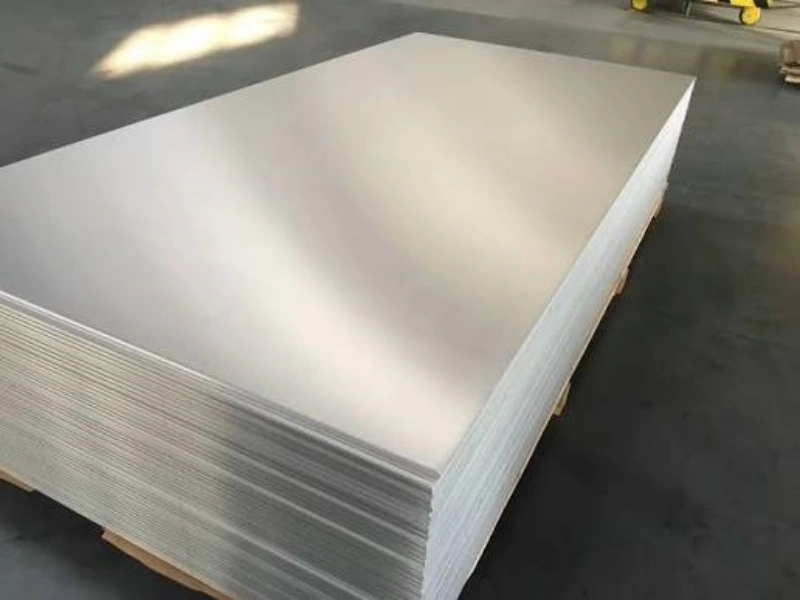
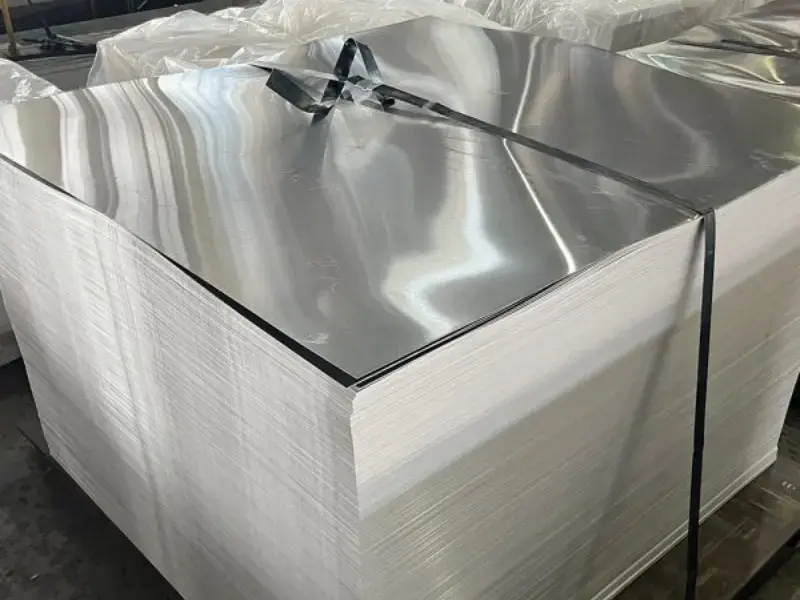
Aluminum Sheet Weight Chart by Thickness
Thickness is one of the main factors affecting aluminum sheet weight.
Standard Aluminum Sheet Weight Table
| Thickness | Weight per Square Meter |
|---|---|
| 0.3 mm | 0.81 kg/m² |
| 0.5 mm | 1.36 kg/m² |
| 0.8 mm | 2.17 kg/m² |
| 1.0 mm | 2.71 kg/m² |
| 1.5 mm | 4.07 kg/m² |
| 2.0 mm | 5.42 kg/m² |
| 3.0 mm | 8.13 kg/m² |
| 4.0 mm | 10.84 kg/m² |
| 5.0 mm | 13.55 kg/m² |
| 6.0 mm | 16.26 kg/m² |
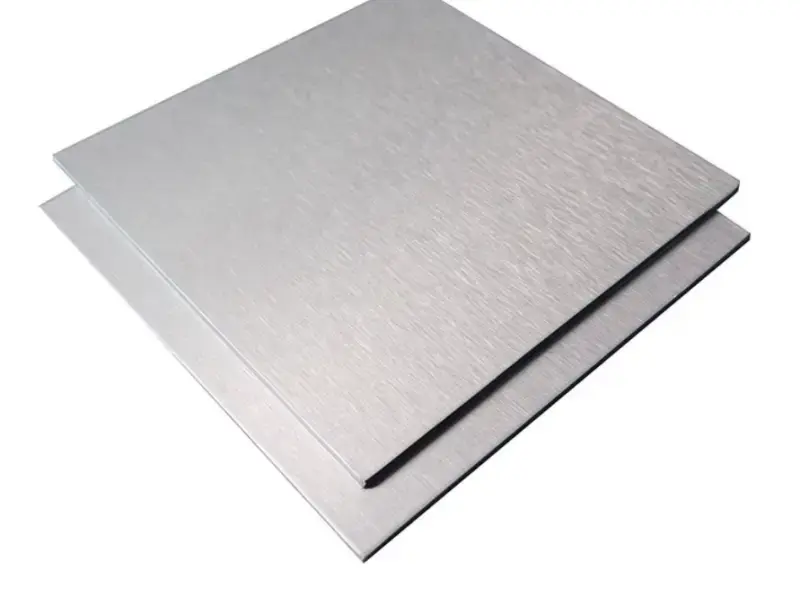
By Common Sizes
4×8 Aluminum Sheet Weight Chart
The 4×8 aluminum sheet is one of the most popular sizes worldwide.
Standard size:
1220 mm × 2440 mm
| Thickness | Approximate Weight |
|---|---|
| 0.5 mm | 4.05 kg |
| 1.0 mm | 8.08 kg |
| 1.5 mm | 12.12 kg |
| 2.0 mm | 16.16 kg |
| 3.0 mm | 24.24 kg |
| 4.0 mm | 32.32 kg |
| 5.0 mm | 40.40 kg |
| 6.0 mm | 48.48 kg |
Applications:
- Sign boards
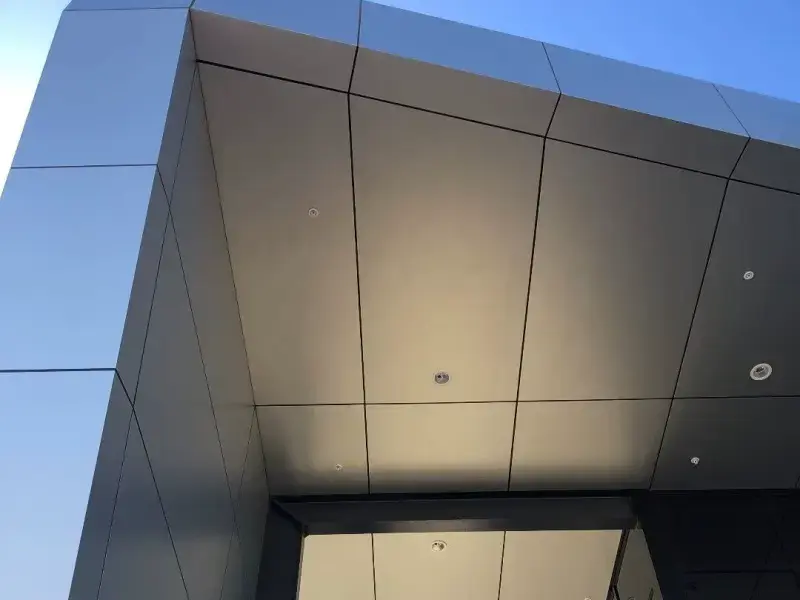
- Wall cladding
- Machine parts
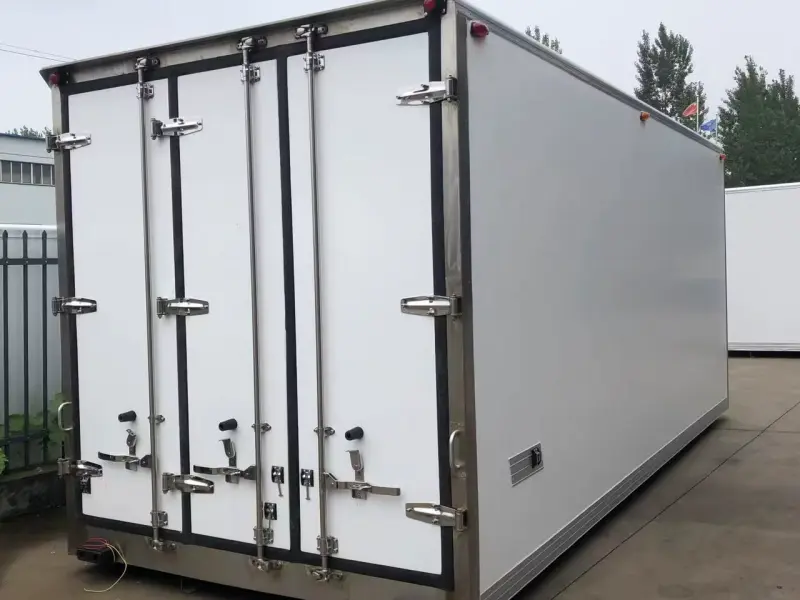
- Truck body panels
- Decoration projects
5×10 Aluminum Sheet Weight Chart
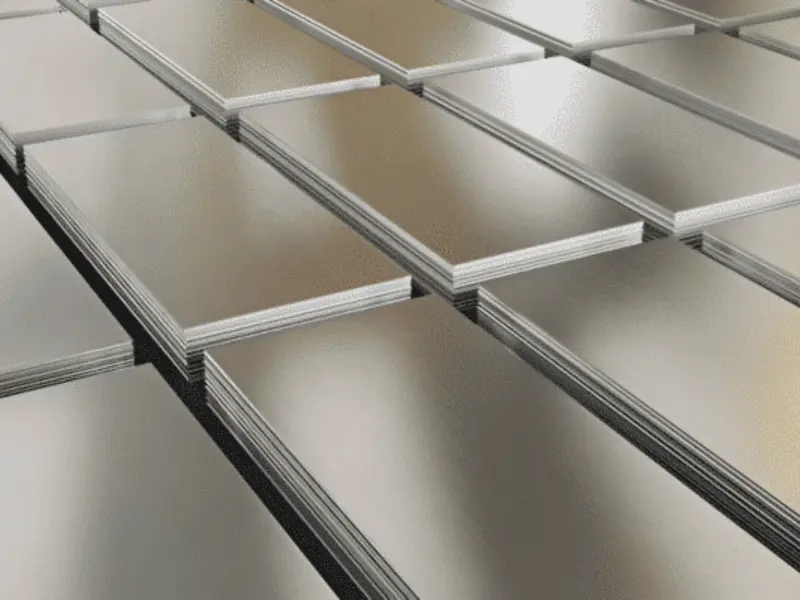
Large aluminum sheets are often used in industrial applications.
Standard size:
1524 mm × 3048 mm
| Thickness | Approximate Weight |
|---|---|
| 1 mm | 12.58 kg |
| 2 mm | 25.16 kg |
| 3 mm | 37.74 kg |
| 5 mm | 62.90 kg |
| 6 mm | 75.48 kg |
Advantages:
- Less joint connection
- Better appearance
- Suitable for large structures
Aluminum Sheet Weight Comparison by Alloy
Different aluminum alloys have slightly different densities and performance.
1000 Series Aluminum Sheet
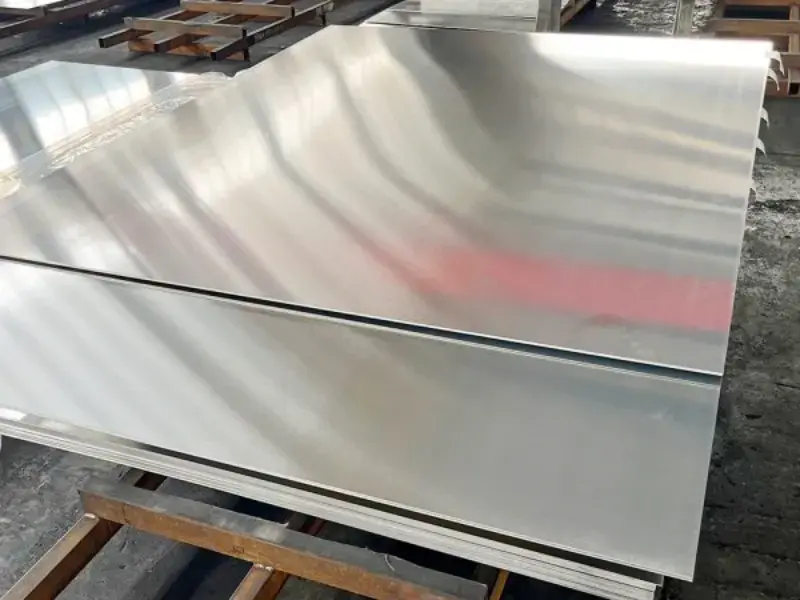
Common alloys:
- 1050
- 1060
- 1100
Features:
- High aluminum purity
- Excellent corrosion resistance
- Good formability
Typical applications:
- Food equipment
- Decoration
- Electrical products
- Reflectors
3000 Series Aluminum Sheet
Common alloy:
- 3003
Features:
- Higher strength than 1000 series
- Good corrosion resistance
- Easy processing
Applications:
- Roofing
- Heat exchangers
- Kitchen equipment
5000 Series Aluminum Sheet
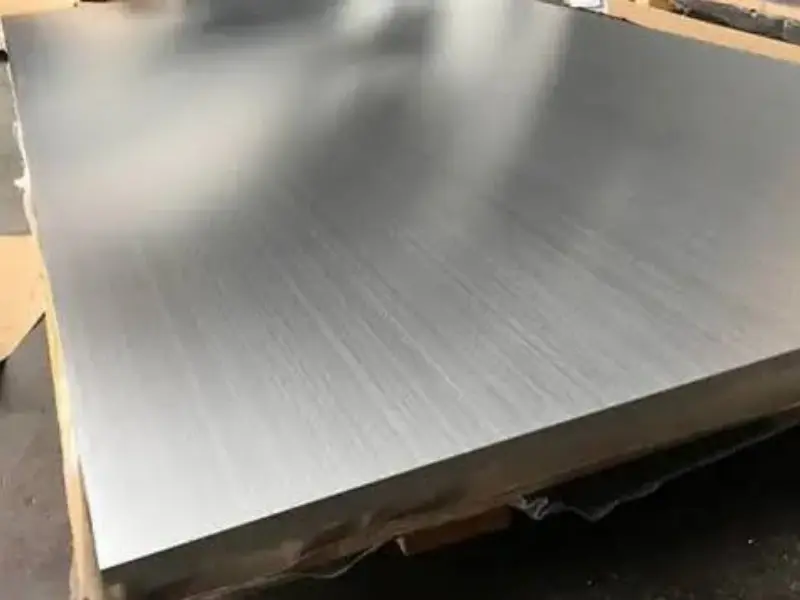
Common alloys:
- 5052
- 5083
- 5754
Features:
- High strength
- Excellent marine performance
- Good welding ability
Applications:
- Ships
- Vehicles
- Pressure equipment
6000 Series Aluminum Sheet
Common alloys:
- 6061
- 6063
Features:
- Heat treatable
- Strong mechanical properties
- Good machining performance
Applications:
- Industrial structures
- Machinery parts
- Frames
Comparison by Alloy Type
| Alloy | Strength | Main Feature | Common Use |
|---|---|---|---|
| 1050 | Low | High purity | Decoration |
| 3003 | Medium | Good forming | Roofing |
| 5052 | High | Corrosion resistance | Marine |
| 5083 | Very High | Heavy-duty use | Shipbuilding |
| 6061 | High | Machinability | Engineering |
Product Type
Plain Aluminum Sheet
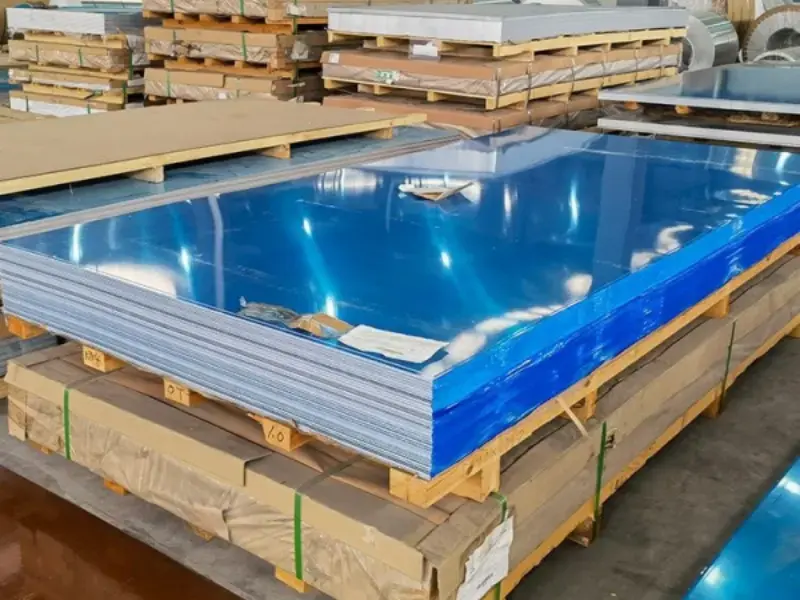
Plain aluminum sheet is the most common product.
Specifications:
| Item | Range |
|---|---|
| Alloy | 1050 / 1060 / 3003 / 5052 |
| Thickness | 0.2-100 mm |
| Width | 100-2600 mm |
| Surface | Mill finish |
Applications:
- General fabrication
- Industrial panels
- Equipment covers
Aluminum Checker Plate Weight
Aluminum checker plate has raised patterns on the surface.
Common thickness:
| Thickness | Weight Increase |
|---|---|
| 2 mm | Slight increase |
| 3 mm | Medium increase |
| 5 mm | Higher strength |
Applications:
- Truck flooring
- Platforms
- Stairs
- Anti-slip flooring
Aluminum Embossed Sheet Weight
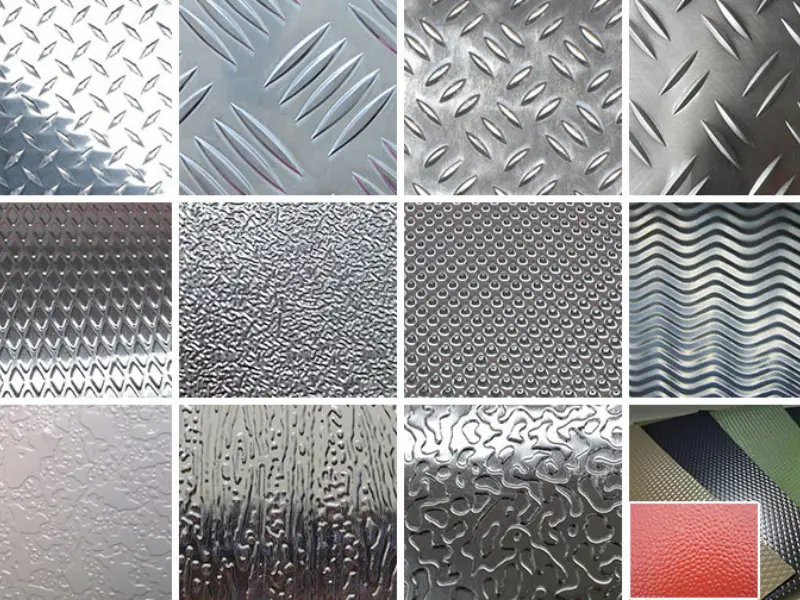
Embossed aluminum sheets include:
- Stucco embossed
- Orange peel pattern
- Diamond pattern
Features:
- Decorative appearance
- Improved surface protection
- Lightweight structure
Applications:
Interior decoration
Refrigerators
Insulation panels
Aluminum Sheet Weight vs Other Metals
Aluminum Sheet vs Steel Sheet
| Feature | Aluminum | Steel |
|---|---|---|
| Density | 2.71 g/cm³ | 7.85 g/cm³ |
| Weight | Lightweight | Heavy |
| Corrosion resistance | Excellent | Needs coating |
| Processing | Easy | Strong |
Aluminum is widely selected when weight reduction is important.
Aluminum Sheet vs Stainless Steel
| Feature | Aluminum | Stainless Steel |
|---|---|---|
| Weight | Lower | Higher |
| Cost | Usually lower | Higher |
| Corrosion resistance | Good | Excellent |
| Appearance | Modern | Premium |
Why Aluminum Sheet Weight Matters?
Transportation Cost Control
Knowing aluminum sheet weight helps customers:
- Estimate shipping cost
- Select proper packaging
- Plan container loading
Example:
A lighter aluminum sheet can reduce:
→ Freight cost
→ Handling difficulty
→ Installation labor
Structural Design
Engineers use aluminum sheet weight data for:
- Load calculation
- Material selection
- Product design
Lightweight aluminum helps reduce overall structure weight.
Production Planning
Manufacturers use weight charts for:
Cost estimation
Material calculation
Cutting plans

Common Aluminum Sheet Sizes and Weight
| Size | Common Thickness | Usage |
|---|---|---|
| 1000×2000 mm | 0.5-5 mm | General use |
| 1220×2440 mm | 0.5-6 mm | Construction |
| 1500×3000 mm | 1-10 mm | Industrial |
| Custom size | Customized | Special projects |
Aluminum Sheet Thickness Selection
Thin Aluminum Sheet
Thickness:
0.2-1.0 mm
Suitable for:
- Decoration
- Electronics
- Signs
- Printing panels
Advantages:
- Lightweight
- Easy cutting
- Easy forming
Medium Thickness Aluminum Sheet
Thickness:
1.5-6 mm
Suitable for:
- Machine covers
- Transportation
- Construction panels
Advantages:
- Balanced strength
- Good processing performance
Thick Aluminum Plate
Thickness:
8 mm+
Suitable for:
- Aerospace parts
- Mold manufacturing
- Heavy equipment
Advantages:
- High strength
- Good stability
How to Calculate Aluminum Sheet Weight
Aluminum sheet weight depends on three main measurements: thickness, width, and length. You must also consider the density of the specific alloy.
Weight Calculation Formulas
You can calculate the weight of any aluminum sheet using these simple formulas:
- Metric Formula:
Weight (kg)=Thickness (mm)×Width (m)×Length (m)×Density (g/cm3) - Imperial Formula:
Weight (lbs)=Thickness (in)×Width (in)×Length (in)×Density (lbs/in3)
Standard Density Values by Alloy Group
The standard reference density for general aluminum is 2.71 g/cm3 (0.0975 lbs/in3). However, different alloying elements alter the weight slightly.
| Alloy Series | Primary Element | Density (g/cm3) | Density (lbs/in3) |
|---|---|---|---|
| 1000 Series | Pure Aluminum (≥99.0%) | 2.71 | 0.098 |
| 3000 Series | Manganese | 2.73 | 0.099 |
| 5000 Series | Magnesium | 2.68 | 0.097 |
| 6000 Series | Magnesium & Silicon | 2.70 | 0.098 |
| 7000 Series | Zinc | 2.81 | 0.102 |
Standard Aluminum Sheet Weight Chart
Below are quick-reference tables for common sheet thicknesses and standard sizes.
Thin Gauge Sheet Weight Chart
Thin sheets are easy to bend and form. They are often used for light trim, sign panels, and food cans.
| Thickness (in) | Thickness (mm) | Weight (lbs/ft2) | Weight (kg/m2) | Weight per 4×8 ft Sheet (lbs) |
|---|---|---|---|---|
| 0.020 | 0.50 | 0.282 | 1.36 | 9.02 |
| 0.032 | 0.80 | 0.451 | 2.17 | 14.43 |
| 0.040 | 1.00 | 0.564 | 2.71 | 18.05 |
| 0.050 | 1.27 | 0.705 | 3.44 | 22.56 |
| 0.063 | 1.60 | 0.888 | 4.34 | 28.42 |
Medium Gauge Sheet Weight Chart
Medium gauges offer balanced strength and flexibility. They are widely used in truck bodies, enclosures, and wall panels.
| Thickness (in) | Thickness (mm) | Weight (lbs/ft2) | Weight (kg/m2) | Weight per 4×8 ft Sheet (lbs) |
|---|---|---|---|---|
| 0.080 | 2.00 | 1.128 | 5.42 | 36.10 |
| 0.090 | 2.30 | 1.269 | 6.23 | 40.61 |
| 0.100 | 2.50 | 1.410 | 6.78 | 45.12 |
| 0.125 (1/8″) | 3.18 | 1.763 | 8.62 | 56.40 |
| 0.160 | 4.00 | 2.256 | 10.84 | 72.19 |
Heavy Gauge Sheet & Plate Weight Chart
Thicker sheets and plates handle heavy mechanical loads, structural framing, and marine hulls.
| Thickness (in) | Thickness (mm) | Weight (lbs/ft2) | Weight (kg/m2) | Weight per 4×8 ft Sheet (lbs) | Weight per 5×10 ft Sheet (lbs) |
|---|---|---|---|---|---|
| 0.190 (3/16″) | 4.80 | 2.679 | 13.01 | 85.73 | 133.95 |
| 0.250 (1/4″) | 6.35 | 3.525 | 17.21 | 112.80 | 176.25 |
| 0.375 (3/8″) | 9.53 | 5.288 | 25.83 | 169.20 | 264.38 |
| 0.500 (1/2″) | 12.70 | 7.050 | 34.42 | 225.60 | 352.50 |

Guide to Popular Aluminum Alloys and Tempers
Selecting the correct alloy family and temper is just as important as choosing the right thickness.
Non-Heat-Treatable Alloys
These alloys gain strength through cold working (strain hardening) rather than heat treatment.
1000 Series (Commercial Pure Aluminum)
- Key Alloys: 1050, 1060, 1100
- Characteristics: Soft, highly ductile, excellent corrosion resistance, superior electrical conductivity.
- Common Use: Chemical equipment, light reflectors, heat exchangers.
3000 Series (Manganese Alloyed)
- Key Alloys: 3003, 3105
- Characteristics: About 20% stronger than 1100 series, good workability, excellent rust protection.
- Common Use: Roofing panels, kitchenware, storage tanks, ductwork.
5000 Series (Magnesium Alloyed)
- Key Alloys: 5052, 5083, 5754
- Characteristics: High strength, excellent saltwater corrosion resistance, outstanding weldability.
- Common Use: Boat hulls, pressure vessels, fuel tanks, highway signboards.
Heat-Treatable Alloys
These alloys are heat-treated to achieve structural-grade strength.
6000 Series (Magnesium & Silicon)
- Key Alloys: 6061, 6082
- Characteristics: Versatile, medium-to-high strength, strong corrosion resistance, good machinability.
- Common Use: Structural frames, bridge decking, truck chassis, precision parts.
7000 Series (Zinc Alloyed)
- Key Alloys: 7075
- Characteristics: High strength comparable to steel, high fatigue strength, lower corrosion resistance.
- Common Use: Aerospace fittings, high-stress military gear, performance racing components.
Temper Designation Overview
T6: Solution heat-treated and artificially aged for maximum hardness.
O: Annealed state (softest condition, max formability).
H14 / H24: Strain-hardened, half-hard condition.
H32: Strain-hardened and stabilized, ideal for 5000 series sheets.
Material Comparisons
Comparing aluminum with other metals or comparing different aluminum grades helps clarify design trade-offs.
Aluminum Sheet vs. Stainless Steel Sheet
Aluminum offers a clear weight advantage over steel while maintaining good durability.
| Feature | Aluminum (5052-H32) | Stainless Steel (304) | Carbon Steel (A36) |
|---|---|---|---|
| Density (g/cm3) | 2.68 | 8.00 | 7.85 |
| Weight Ratio | 1.0 (Base reference) | ≈3.0× heavier | ≈2.9× heavier |
| Corrosion Resistance | High (Self-passivating oxide) | Very High | Low (Requires painting) |
| Formability | High | Medium | Medium |
| Best For | Weight savings, outdoor use | Sanitary & high-temp areas | Low-cost structural frames |
5052-H32 vs. 6061-T6 Aluminum Sheet
These two grades are widely used, but they suit different fabrication methods.
lesscopydownload [ Sheet Metal Work ]
│
┌───────────────┴───────────────┐
▼ ▼
[ Alloy 5052-H32 ] [ Alloy 6061-T6 ]
• Non-Heat Treatable • Heat Treatable
• Density: 2.68 g/cm³ • Density: 2.70 g/cm³
• Great Bending Radius • Tends to Crack on Tight Bends
• High Marine Resistance • High Structural Yield Strength
• Ideal for Sheet Stamping • Ideal for CNC Machining
Material Selection Pathways for Industry Projects
Follow these operational pathways to pick the right sheet specifications for your project requirements.
Marine and Offshore Construction Pathway
Environment: Saltwater Exposure→Select Alloy: 5052 or 5083→Choose Temper: H32 or H111→Sheet Thickness: 3.0mm – 6.0mm→Result: Lightweight, Non-Corroding Hull Panel
Architectural and Building Facade Pathway
Environment: Outdoor Weathering→Select Alloy: 3003 or 5052→Choose Temper: H14 or H32→Surface Finish: Anodized or PVDF Coated→Result: Durable Curtain Wall Cladding
Automotive and Transportation Body Pathway
Environment: Dynamic Mechanical Load→Select Alloy: 6061-T6→Processing: Laser Cutting & CNC Milling→Thickness: 2.0mm – 4.0mm→Result: Rigid Fuel Tank & Chassis Frame
Essential Buyers Checklist for Estimating Project Weight
When planning raw material orders based on aluminum sheet weight charts, keep these points in mind:
- $\bullet$ Check Thickness Tolerances: Rolling mills have standard thickness allowances (±0.02mm to ±0.08mm). Actual sheet weight may vary slightly from theoretical chart values.
- $\bullet$ Include Protective Films: PE protective film or paper interleaving adds around 0.01 kg/m2 to shipment gross weight.
- $\bullet$ Factor in Anodizing & Coatings: Powder coating adds a slight amount of surface mass, while anodizing transforms the top metal layer without increasing weight.
- $\bullet$ Account for Pallet & Packaging Weights: Wooden skids and steel strapping add 15 kg to 40 kg per pallet bundle.
Factory Supply of Aluminum Sheets

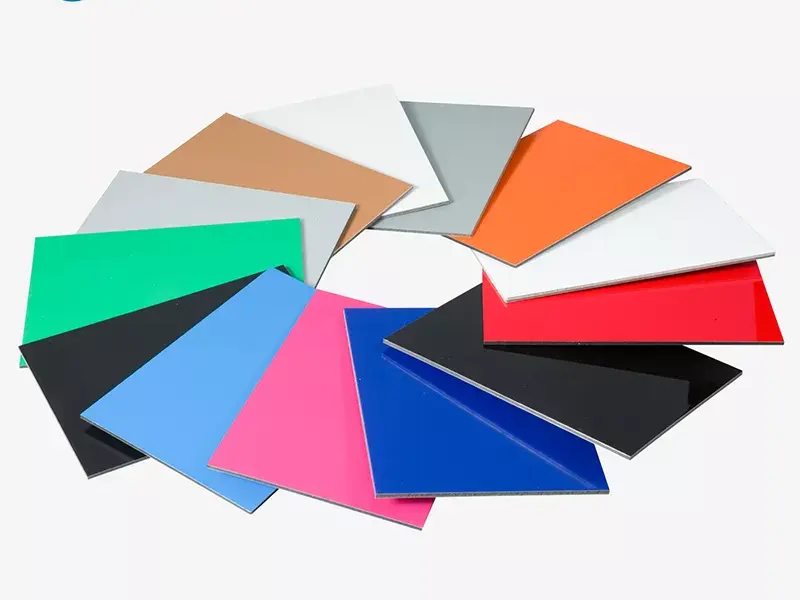
Our factory provides different aluminum sheet solutions for global customers.
Available products:
- Aluminum sheet
- Aluminum plate
- Aluminum coil
- Aluminum checker plate
- Aluminum embossed sheet
- Aluminum sublimation sheet
Customized Aluminum Sheet Service
We provide:
| Service | Options |
|---|---|
| Alloy | 1050 / 1060 / 1100 / 3003 / 5052 / 6061 |
| Temper | O / H12 / H14 / H24 / H32 / T6 |
| Thickness | Customized |
| Width | Customized |
| Length | Customized |
Aluminum Sheet Packaging and Delivery
Proper packaging protects aluminum sheets during transportation.
Common methods:
| Packaging | Function |
|---|---|
| Wooden pallet | Strong support |
| Waterproof paper | Moisture protection |
| Protective film | Surface protection |
Export packaging is suitable for:
- Ocean shipping
- Truck transportation
- Long-distance delivery
FAQ
How much does a 4×8 aluminum sheet weigh?
The weight depends on thickness.
For example:
A 4×8 aluminum sheet with 1 mm thickness weighs about 8 kg.
How do I calculate aluminum sheet weight?
Use:
Length × Width × Thickness × Aluminum Density
The standard aluminum density is about 2.71 g/cm³.
Does aluminum alloy affect sheet weight?
Yes. Different alloys have slightly different densities, but the main weight difference comes from thickness and size.
What is the lightest aluminum sheet?
Thin aluminum sheets such as 0.2 mm or 0.3 mm sheets have the lowest weight.
They are commonly used for:
- Printing
- Decoration
- Electronics
What aluminum sheet is best for outdoor use?
5052 and 3003 aluminum sheets are commonly selected because they provide:
- Good corrosion resistance
- Better strength
- Long service life
Can aluminum sheet size and weight be customized?
Yes.
Manufacturers can provide:
- Custom thickness
- Custom width
- Custom length
- Special alloy options